
AUD to USD Exchange Rate Today: What A$1,000 Buys


Published spot quotes tracked by Trading Economics put AUD/USD at US$0.7029–US$0.7030 per Australian dollar on 26 October 2026. The rate moves through the day, so a displayed figure is a market observation, and the conversion rate a money-transfer provider offers can sit above or below it.
The more useful question is how much reaches the recipient. A market quote gives you a benchmark, but the provider's conversion margin, transfer charges and payment timing determine whether that benchmark translates into good value.
Table of Contents
- Today's AUD to USD Rate at a Glance
- What A$1,000 Becomes in US Dollars
- What Moves the AUD to USD Rate
- AUD to USD History From 2024 to 2026
- Mid-Market Rate Versus a Provider's Posted Rate
- How to Compare Two Quotes Step by Step
- Edge Cases That Change the Final Amount
- Decide Whether to Convert Now or Schedule Your Transfer
Today's AUD to USD Rate at a Glance
A$1 was quoted near US$0.7030 in the late-October snapshot below, compared with a 0.7020 daily close three days earlier. Read AUD/USD as US dollars per Australian dollar: a higher quote means each A$ buys more USD, and a lower quote means it buys less.
For the earlier reference point, Yahoo Finance reported an AUD/USD closing rate of 0.7020 on 23 October 2026, with an intraday low of 0.7006 and high of 0.7039.
AUD to USD rate snapshots from recent sources
| Date | Source | Rate (USD per 1 AUD) | Intraday range | Bid / ask |
|---|---|---|---|---|
| 23 Oct 2026 | Yahoo Finance daily close | 0.7020 | 0.7006 to 0.7039 | Not shown |
| 26 Oct 2026 | Trading Economics published spot quotes | 0.7029 to 0.7030 | 0.7026 to 0.7040 | 0.7029 / 0.7031 |
The 26 October quote comes from Trading Economics. Neither observation includes an exact capture time or time zone, so treat both as dated reference points; neither is an executable live quote.
The bid is what the market pays to buy AUD, the ask is what it charges someone buying AUD, and the mid-market rate sits halfway between them. That midpoint is the benchmark. A sender's outcome depends on the provider's posted conversion rate, any margin against mid-market, charges and timing.
Practical rule: Match the direction of the currency pair before comparing rates. AUD/USD and USD/AUD describe opposite conversions.
When you search for the AUD to USD exchange rate today, identify whether the page shows a live quote, a delayed observation or a daily close. Then compare like with like: same pair direction, same timestamp basis, and the USD amount the recipient would get. A snapshot can anchor the check, while the funded transfer settles at the provider's terms.
What A$1,000 Becomes in US Dollars
On 26 October 2026, Trading Economics showed published spot quotes clustered around 0.7029–0.7030 USD per AUD, alongside a bid/ask of 0.7029/0.7031 and an intraday range of 0.7026–0.7040. Its transfer example puts the cost of a 0.5% spread on A$1,000 at roughly US$3.52.
Start with the market value
For a worked illustration, take the upper end of that spot reference as the benchmark. Multiply the Australian-dollar amount by the benchmark, then deduct the assumed spread.
The calculations below are hypothetical illustrations derived from that reference, not provider quotes. They assume the spread reduces the benchmark USD value and exclude any separate charge.
Conversion at 0.7030 with a 0.5% spread
| AUD amount | Mid-market USD value | Cost of 0.5% spread (USD) | USD after spread, before fees |
|---|---|---|---|
| A$100 | US$70.30 | US$0.35 | US$69.95 |
| A$1,000 | US$703.00 | US$3.52 | US$699.49 |
| A$2,500 | US$1,757.50 | US$8.79 | US$1,748.71 |
| A$10,000 | US$7,030.00 | US$35.15 | US$6,994.85 |
Amounts are calculated at full precision and rounded independently to cents. That matters in the middle row: subtracting an already-rounded spread cost can produce a different displayed cent from rounding only the final result.
Check how the fee is collected
A separate charge changes the calculation according to its currency and collection method. If the provider deducts an AUD fee from your sending amount before conversion, you must reduce the amount being converted first.
If it deducts a USD fee after conversion, use:
USD received = AUD converted × benchmark rate × (1 − spread) − USD fee
If the provider adds its fee to your payment instead, compare providers using the same total AUD outlay. Otherwise, a quote may appear more generous just because you're paying more.
The table isolates the spread so you can see its effect. Your actual decision should use the recipient amount and the total amount you must pay, with the fee treatment made explicit.
What Moves the AUD to USD Rate
Currency traders respond to changes in expected returns, export demand and financial risk. Those forces help explain why AUD/USD changes, but they don't provide a reliable signal for the next quote.
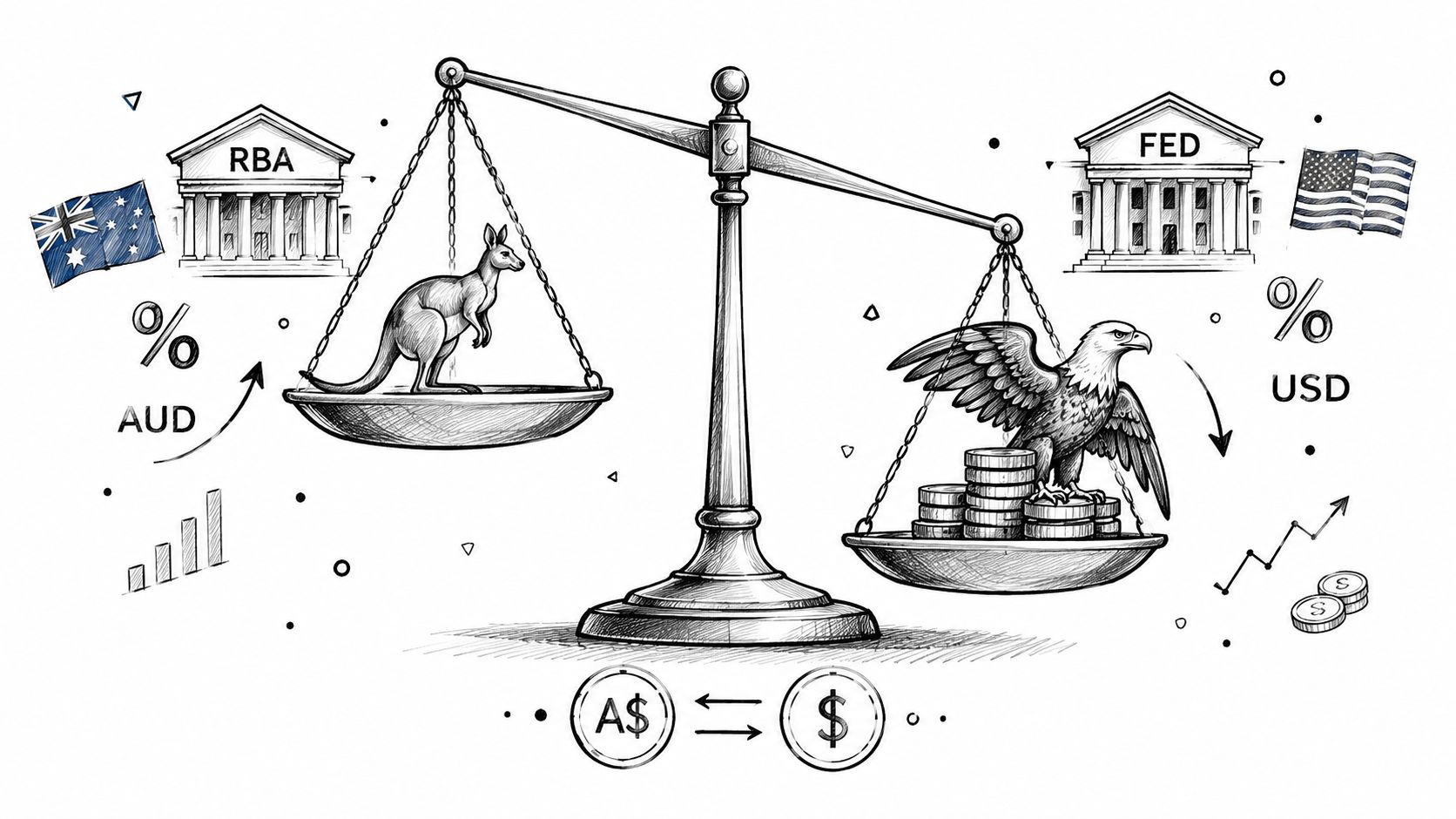
- Relative interest rates. If traders expect Australian interest rates to rise relative to US rates, holding AUD assets can become more attractive. Expectations about the Reserve Bank of Australia and US Federal Reserve matter, not just their latest decisions.
- Commodity demand. Prices and demand for iron ore, coal and LNG affect Australian export receipts. Stronger demand from Chinese buyers can support the AUD, although other pressures may offset it.
- Broad US dollar demand. Investors buying USD across currencies can push AUD/USD lower even without a major Australian announcement.
- Risk appetite. Investors may favour the Australian dollar when they're comfortable holding economically sensitive assets. During a sell-off, demand for more defensive holdings can work against it.
- Economic releases. Australian employment and inflation releases, US inflation figures and central-bank decisions can change traders' expectations quickly.
These are mechanisms, not explanations to attach automatically to every movement. A release can look strong in isolation yet weaken a currency if traders expected something stronger.
A correct view of the economy doesn't guarantee a better transfer rate. Traders may already have priced that view into the quote.
Before a time-sensitive business payment, check an economic calendar for announcements near your intended conversion time. Use it to recognise uncertainty, not to assume you can predict the reaction.
For a sender, the practical distinction is between a flexible conversion and a payment with a deadline. Missing that deadline can be more consequential than getting a slightly less favourable exchange rate.
AUD to USD History From 2024 to 2026
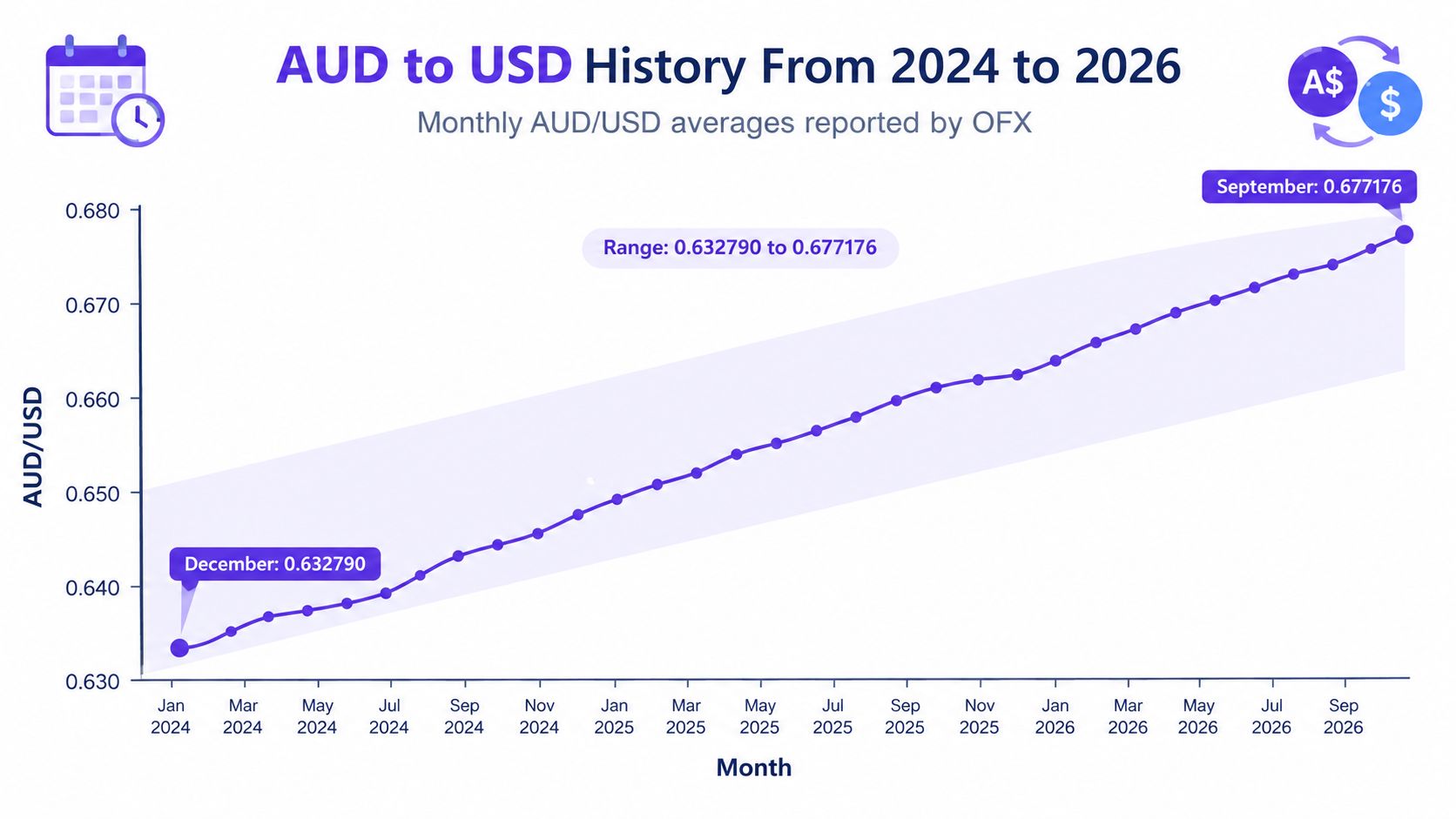
For 2024, OFX reported monthly AUD/USD averages ranging from 0.632790 in December to 0.677176 in September. Those are monthly averages, not the lowest and highest individual trades of the year.
A differently quoted series needs care: LiveRates.io reported a 2024 USD/AUD average of 1.5151, with a yearly low of 1.4439 and high of 1.6144. USD/AUD measures Australian dollars per US dollar, so its direction is the reverse of AUD/USD.
Keep averages and ranges separate
To reverse an individual exchange-rate observation, take its reciprocal. But the reciprocal of an annual average isn't necessarily the annual average of the reciprocal series, so it shouldn't be presented as an independently established AUD/USD average.
The 2024 endpoints describe a range, not a path. September precedes December on the calendar, so the monthly average moved from that September high down toward the December low rather than climbing steadily through the year. A single rising line connecting the two points would misrepresent their order.
Spot quotes from later dates can sit above those earlier monthly endpoints, yet comparing a spot quote with a monthly average doesn't establish a smooth upward trend. The measures answer different questions: one records a price at a single moment, the other condenses a month of trading into one figure.
For budgeting, history helps you recognise that a familiar rate isn't a permanent entitlement. For a longer-term comparison, use the publishers' underlying tables and keep the quotation direction, observation frequency and averaging method consistent.
Mid-Market Rate Versus a Provider's Posted Rate
The provider's posted rate is the conversion offer on its quote screen. It may incorporate a margin relative to the market benchmark, which means a transfer can carry a conversion cost even when the separate fee line is empty.
Where each number in a quote comes from
| Component | Where it appears | What it tells you |
|---|---|---|
| Mid-market rate | Market data pages such as Yahoo Finance or Trading Economics | A benchmark without the provider's customer margin |
| Provider rate | Quote or preview screen before confirming | The conversion rate offered to you |
| Margin | Difference between comparable market and provider rates | The cost incorporated into the exchange rate |
| Fixed or percentage fee | Fee line or payment breakdown | An additional charge and how it's collected |
| USD received | Final preview line | The quoted recipient amount, subject to any stated conditions |
For a useful explanation of the distinction between a visible charge and a cost built into the rate, consult Suby's guide to currency conversion fees. Don't interpret a fee-free label as proof that the conversion matches the market benchmark.
Our guide to choosing an online money-transfer platform provides broader context for comparing services. Confirm that AUD-to-USD transfers are available for your account before relying on any provider.
Also establish whether the receiving bank can deduct a charge. The quoted payout and the amount ultimately credited aren't interchangeable unless the applicable conditions support that conclusion.
How to Compare Two Quotes Step by Step
Compare like with like: the same sending budget, the same payout currency and the same delivery method. A bank-account payout and a different collection method may carry different charges or conditions.
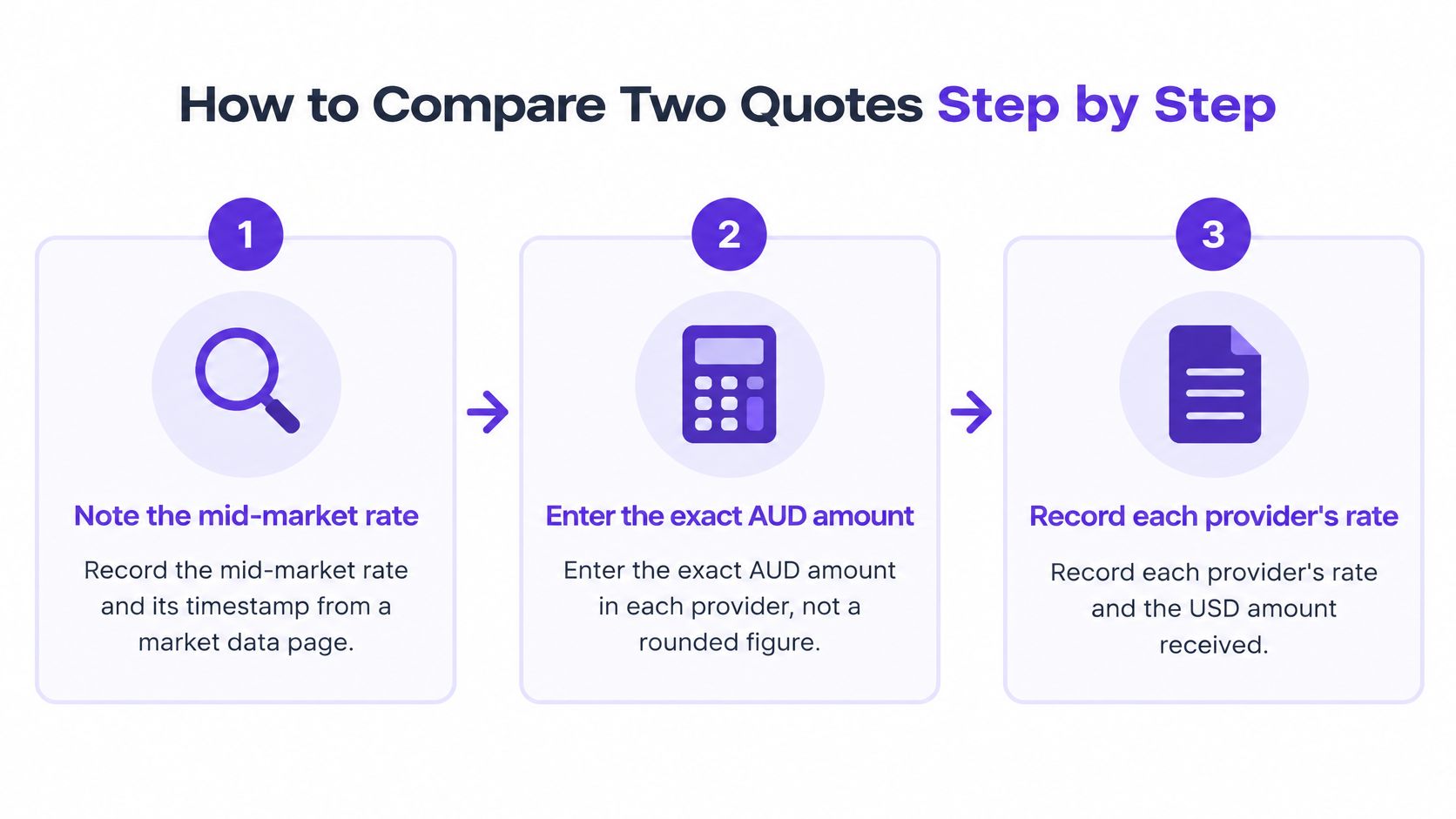
Record the market benchmark. Save the rate, quotation direction and timestamp from a market data page. Without the timestamp, you can't separate a provider's margin from a market movement.
Enter your exact AUD budget. Establish whether that budget includes fees or whether the provider will charge them separately. Rounded or inconsistent budgets make the recipient amounts less comparable.
Capture the offer details. Record the provider rate, total AUD payable and quoted USD payout. Keep the payout method consistent across providers.
Calculate the rate gap. Use
(mid-market rate − provider rate) ÷ mid-market rate, then express the result as a percentage. This isolates the difference in the conversion rate before separately charged fees.Account for fees without double-counting. If the preview has already deducted a fee from the payout, don't subtract it again. For an all-in comparison, divide the quoted USD payout by the total AUD payable.
Read the validity conditions. Establish whether the offer is locked, when the lock expires and what happens if funding arrives later. A saved preview isn't automatically a guaranteed rate.
Refresh both offers close together. Comparing an old quote with a fresh one can confuse timing with price. Re-enter the details if either offer has expired.
Choose using payout and execution requirements. Prefer the suitable offer that delivers more USD for the same total AUD cost, provided its delivery conditions meet your deadline.
Our tips for finding better exchange rates can help organise the comparison beyond the headline quote.
For a hypothetical worked example, suppose the provider's rate is below the market benchmark and it adds no separate charge. Multiply the same AUD amount by each rate; the difference between those USD results is the conversion cost. If another provider offers a higher rate but deducts a fee, subtract that fee before deciding which offer delivers more.
Edge Cases That Change the Final Amount
A rate that stays open while you arrange payment creates uncertainty between preview and conversion. The question isn't just whether the provider showed the correct rate initially, but which event determines your final rate.
Situations that change the USD amount
| Situation | Effect on the USD amount | What to do |
|---|---|---|
| Weekend or holiday quote | The display may use the last available market observation or different pricing conditions | Check the timestamp and whether the quote is executable |
| Rate moves between preview and payment | The final payout can change if the rate isn't locked | Confirm the validity window and funding deadline |
| Intraday movement | Quotes taken at different times may differ without a change in provider margin | Compare refreshed offers close together |
| Fixed fee on a small transfer | The charge consumes a larger share of the converted value | Compare the payout against your total AUD cost |
| Receiving-bank charge | The bank may credit less than the amount sent | Establish whether bank deductions are included or excluded |
| Rounding of rate or amount | Displayed arithmetic may not exactly reproduce the final calculation | Use the contractual quote and final preview as references |
Save the conditions, not just the rate
Keep the transaction reference and a copy of the final confirmation. Capture the total paid, payout amount, destination details and any statement about a rate lock or downstream deductions.
A screenshot of a market page can establish what you saw, but it doesn't establish what the provider agreed to deliver. The provider's accepted transaction terms are more useful if you need to question a discrepancy.
Before paying: Distinguish a guaranteed recipient amount from an estimate that excludes receiving-bank charges.
Rounding also deserves proportionate attention. A minor display difference isn't the same issue as an undisclosed deduction, an expired rate or an incorrectly entered recipient currency.
Decide Whether to Convert Now or Schedule Your Transfer
If the money is needed now and the quoted payout falls within your acceptable conversion cost, complete the transfer rather than treating a payment obligation as a currency trade. Waiting only makes sense if your deadline and budget can tolerate an unfavourable movement.
For recurring payments, scheduling can make administration more consistent. It doesn't automatically make the exchange rate predictable: establish whether conversion happens when you schedule, when you fund or when the transfer executes.
Use the tools for a defined decision
Our Check Rates feature lets customers compare current and previous exchange rates. We display the exchange rate and recipient amount before completion, with no hidden fees, and Schedule Transfer lets customers send later or regularly at a particular time. Confirm AUD-to-USD availability for your account and the applicable rate-setting conditions before relying on a scheduled payment.
Readers managing other Australian-dollar remittances can also consult our guide to sending money from Australia to Nigeria at the best rates. Availability and payout arrangements should be checked for the actual destination rather than assumed across routes.
Enter your exact AUD budget, record the quoted USD payout and compare it with a contemporaneous market benchmark using the steps above. Confirm only when the cost, rate validity and delivery conditions meet your needs.
Africhange offers exchange-rate checks, an upfront recipient-amount preview and scheduled transfers to help you plan cross-border payments. Visit Africhange to confirm your available currency route and review the amount your recipient would receive before completing a transfer.