
Currency Exchange Rate by Date: How to Find Any Past Rate


An invoice from your Nigerian supplier is dated 27 March 2024, and the rate you booked that month doesn't match the one your bank shows for the same day. You search the pair, write down a number, then find a second site with a different one. Neither page is broken.
A currency exchange rate by date isn't a single fact sitting in a vault. It's whichever number one publisher recorded, at a stated time, under a stated convention, for a stated unit. Most of the confusion around historical rates comes from comparing two numbers that were never built to be compared.
What follows covers what a date lookup returns, why weekends and currency reforms change what a date means, and how to construct a rate for pairs nobody publishes directly.
Table of Contents
- Historical Rates for One Date at a Glance
- Why the Same Date Can Show Different Rates
- How to Look Up a Currency Exchange Rate by Date
- Finding Rates for Pairs Without a Direct Quote
- Weekends, Holidays, Time Zones and the Transfer Rate
- Comparing Two Dates Without Misreading the Change
Historical Rates for One Date at a Glance
Three figures, one pair, one quote direction. Every row below reads as Canadian dollars per one US dollar, so the numbers can sit side by side without converting anything.
| Reference point | Date or period | CAD per USD | Source |
|---|---|---|---|
| Annual average | 2024 | 1.3698 | Bank of Canada |
| Daily rate | 27 March 2024 | 1.3587 | Bank of Canada |
| Daily rate | 27 March 2025 | 1.4309 | Bank of Canada |
The two daily values come from the Bank of Canada's daily exchange-rate lookup, which recorded 1.3587 Canadian dollars per US dollar on 27 March 2024 and 1.4309 Canadian dollars per US dollar on 27 March 2025. The annual row is a different kind of object: the Bank of Canada's annual average series puts 2024 at 1.3698 Canadian dollars per US dollar, a twelve-month summary that won't match any single day's quote.
Read the row type before you reuse a number. An annual average answers what the year looked like overall, while a daily figure answers what was quoted on one date. Put both in the same spreadsheet and you get a comparison that looks precise and carries no meaning.
The two daily rows sit exactly a year apart and differ by 0.0722 Canadian dollars per US dollar. That gap becomes comparable only as a share of the earlier rate, and only once both figures are confirmed to be the same type.
Four details to capture with any rate
- The date. A specific business date, not a month or a year. Historical series are built on individual days, and a lookup for the wrong day can move more than the trend you're investigating.
- The quote direction. Write "CAD per USD" or "USD per CAD" explicitly. The same market fact inverts to a different number, and a missing direction turns a clean figure into an ambiguous one.
- The publisher. A central bank reference number and a provider quote come out of different processes, and they're not interchangeable.
- The rate type. Reference, market snapshot, card network, customer rate. A number without that label is half a fact.
Copy those four fields onto a row for your own pair. It takes ten seconds and settles arguments later.
Why the Same Date Can Show Different Rates
A date lookup can return several valid figures for the same currency pair. The difference is usually the rate's purpose, publisher, or timing, rather than an error. A reference rate, a market snapshot, and the amount a customer is offered answer different questions.
A central bank reference rate is a benchmark calculated from a defined set of quotes and published on working days. It can help with comparisons, but it is not an offer to exchange money. An interbank snapshot records a market price at a particular moment, so figures taken hours apart may differ as prices move. A card network rate applies when a card transaction settles in another currency. It reflects the network's wholesale level and may also include the issuer's margin.
A provider rate for a remittance starts from a market level and includes a provider margin, so it may differ from a headline rate. The rate and amount a customer sees before completing a transfer are more directly relevant to the amount the recipient will receive. For example, an international payment platform can show a customer-facing rate rather than just a market reference. An accounting rate, meanwhile, is selected by a company to keep figures consistent across a reporting period. It is used for records, not as a price at which people trade.
The direction trap
Quote direction changes the number without changing the underlying market relationship. A rate of 1.43 Canadian dollars per US dollar is roughly 0.70 US dollars per Canadian dollar, because the second figure is the reciprocal of the first. Two sources can show these figures and agree completely. Check which currency is in the denominator before comparing rates.
Check the arrow before the number. A reversed quote describes the same relationship in the opposite direction.
Why old series get rewritten
Historical data can also change in meaning as currencies and data series change. The IMF exchange rate database country notes explain that historical series may be adjusted when a country adopts a new currency or redenominates. Official conversion factors can express the full series in the current currency unit. A long-running series may therefore connect old and new figures mathematically, while the currency unit or conditions behind those figures have changed. A value from an earlier decade may not describe the same unit or trading conditions as a value today.
What the monetary era changes
The rules governing exchange rates have changed over time, so a figure's date matters as well as its publisher. At the July 1944 Bretton Woods conference, delegates from 44 nations established a fixed-rate system centred on the US dollar and linked to gold. It continued for nearly three decades. President Richard Nixon suspended dollar convertibility into gold in August 1971. After crises in February and March 1973, floating rates became the norm among major industrialised democracies, as described in the US State Department's history of Bretton Woods.
| Period | Regime | How to read the rate |
|---|---|---|
| July 1944 to August 1971 | Fixed rates linked to gold, with the US dollar at the centre | Officially managed levels, not free market prices |
| August 1971 to March 1973 | Transition after dollar convertibility to gold was suspended | Expect breaks and mixed regimes when comparing across this period |
| 1973 onward | Floating rates as the norm for major industrialised democracies | Market-determined, so compare with the volatility of that date |
A figure from 1965 represents an administered level, while a figure from 2015 reflects a market price. Treating both as the same kind of observation can make a comparison misleading. Before drawing conclusions, identify the rate type, confirm the quote direction, and check whether a provider margin or other charge is already included.
How to Look Up a Currency Exchange Rate by Date
The routine below works for any pair and any publisher. It takes about two minutes per date and produces a record you can defend a year later.
The graphic below condenses the sequence.
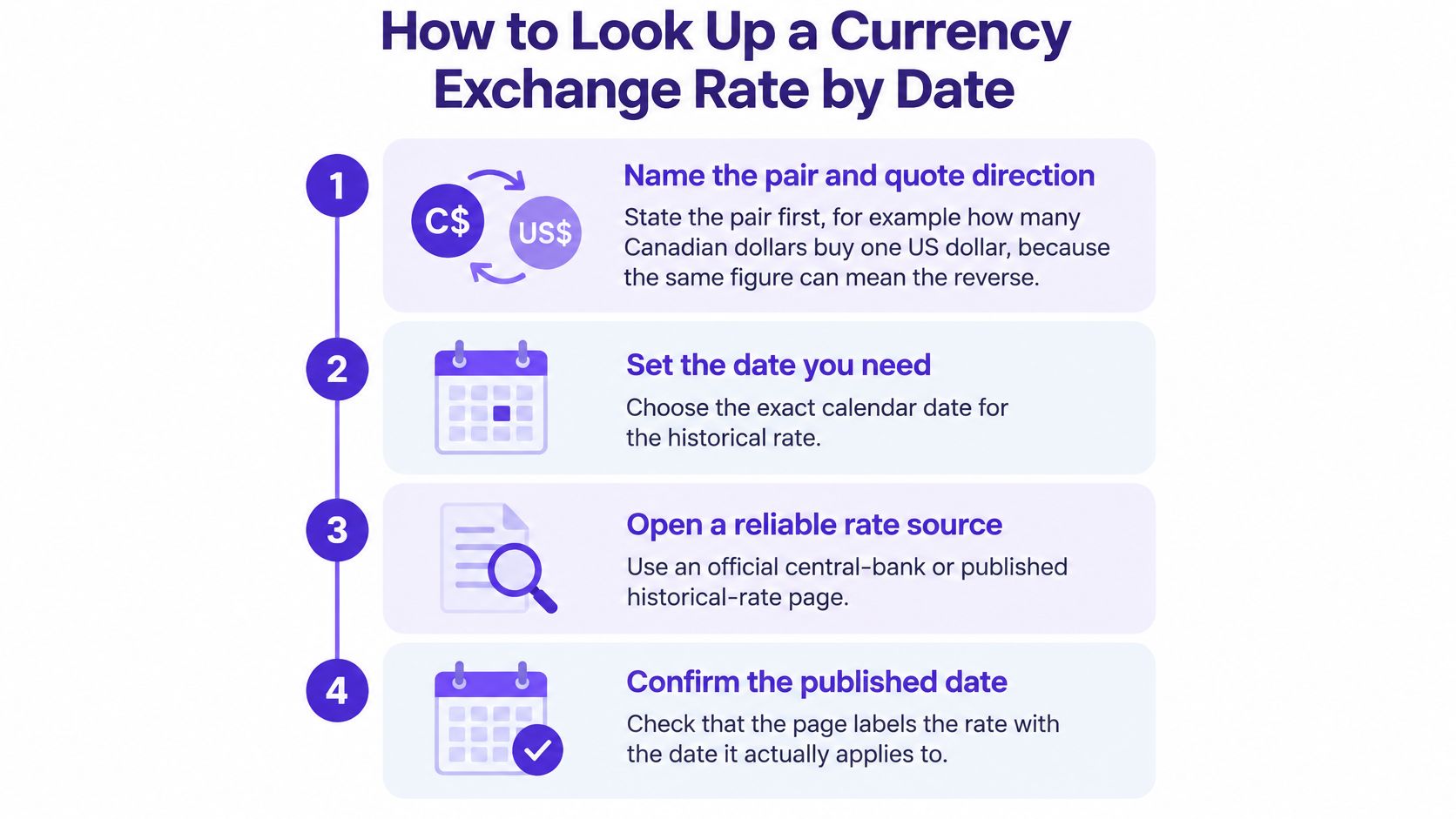
- Name the pair and the direction. Write "CAD per USD" on the page before you search anything. Most bad comparisons trace back to a figure quoted the other way round, which isn't a disagreement between sources but a misread sentence.
- Fix the exact date, then check it traded. A date that falls on a Saturday in one market and a public holiday in the other gives you no observation at all. Pick the nearest business day both currencies traded and note it.
- Open an official series rather than an aggregator. The Federal Reserve's H.10 release publishes daily bilateral rates for major currencies against the US dollar using noon buying rates in New York for cable transfers, and since 5 January 2009 the Fed has distributed those observations through a weekly release covering the previous business week rather than a daily update. The day you want may appear with a lag, so look for the specific dated observation instead of the latest headline.
- Read the convention before the number. A noon buying rate in New York is a wholesale reference taken at a set hour. It isn't the rate a card network or a transfer provider will apply to your payment, and it carries no spread.
- Write one line you could hand to someone else. Date, pair in words, direction, value with its unit, publisher, rate type. If a field is missing, the record isn't finished.
- Convert or compare only once the record exists. Multiply an amount by the rate after the direction is confirmed, and keep the original date attached to the result. A converted figure with no date on it can't be audited.
The order matters more than the tool. Rate errors are rarely arithmetic mistakes. They come from doing the multiplication before the direction and the date were written down.
For CAD pairs, the Bank of Canada's daily lookup gives the same structure under a Canadian publishing convention. For major pairs against the dollar, the Fed series is where most desks start. Neither is a quote you can transact on.
Finding Rates for Pairs Without a Direct Quote
Many pairs a reader needs have no published line of their own. Naira against the Canadian dollar is a good example: both currencies quote against the US dollar, and the pair itself is built rather than quoted. The method is division. The discipline is in matching dates and directions.
Build the cross in three steps
- Pull both dollar rates for the same date. Same publisher where you can, same quote direction, both expressed as units of the foreign currency per one US dollar.
- Check the direction of each leg. If one source quotes dollars per unit rather than units per dollar, invert it first and note in your record that you did.
- Divide one by the other. Units of currency A per dollar, divided by units of currency B per dollar, gives units of A per unit of B. That's your cross rate.
The same thing in symbols
If one US dollar buys X Canadian dollars and Y naira on the same date, then one Canadian dollar buys Y divided by X naira. Swap the letters and it holds for any pair, which is why the direction check carries more weight than the arithmetic itself. Round only the final figure and keep the unrounded inputs in your record, because the next calculation built on a rounded cross will drift.
For a naira leg, take the figure from the central bank that publishes it rather than a secondary table. The notes attached to that series tell you which date range is directly observed and which is reconstructed, and that distinction survives into any comparison you make. The CAD to naira conversion walkthrough works the full chain end to end if you want to check your arithmetic against a finished example.
Save both source rates, the cross you calculated and the date. Anyone should be able to rebuild your number from those four pieces without asking a question.
Weekends, Holidays, Time Zones and the Transfer Rate
The assumption almost everyone brings to a lookup is that the date typed in is the date of the rate that comes back. On a Saturday or a public holiday, it isn't. The page returns the last business-day value and, too often, doesn't say so.
The illustration below shows the case that often causes confusion.
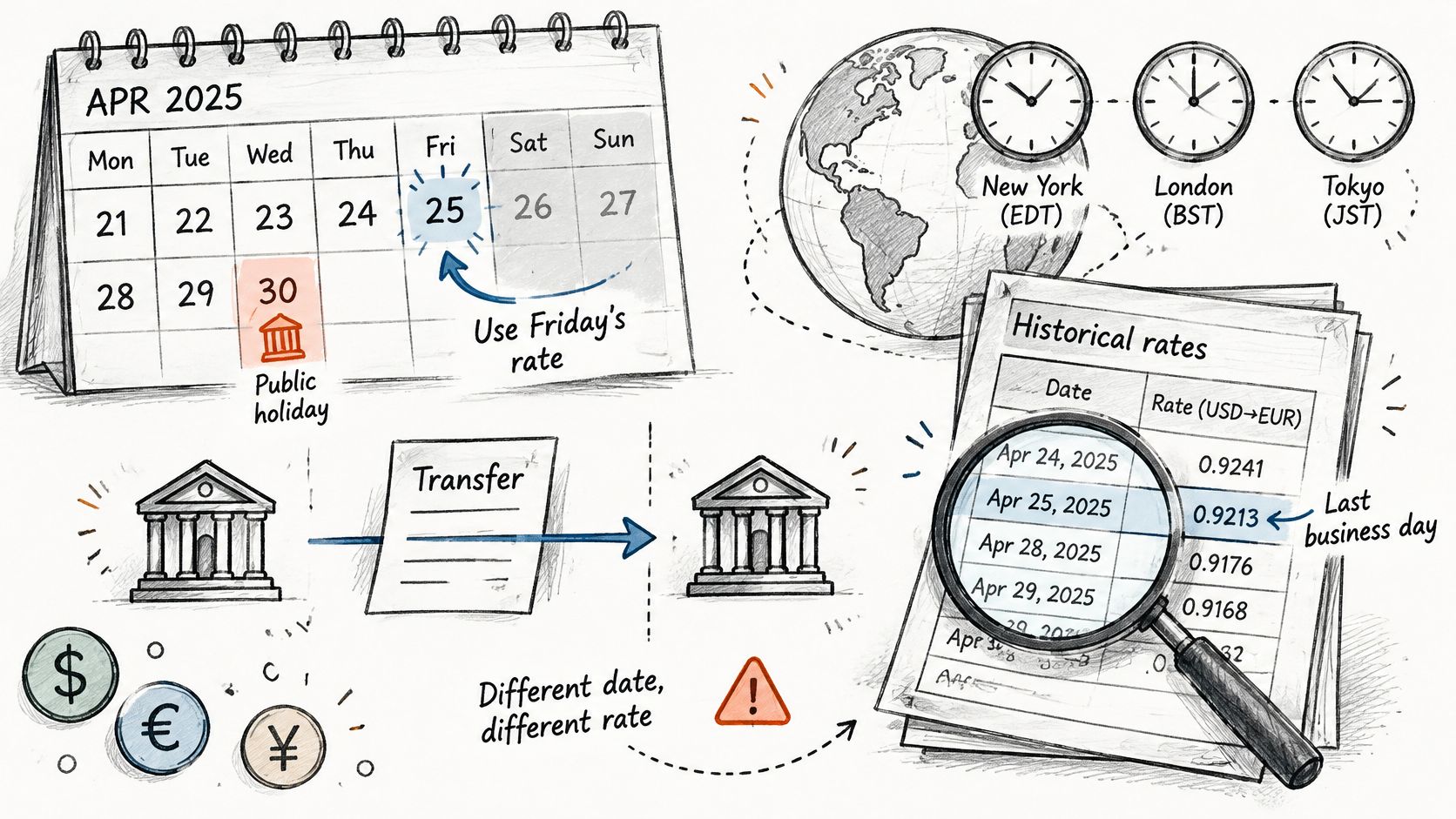
| Date situation | Rate usually shown | What to check |
|---|---|---|
| Weekday with normal trading | Same-day reference rate | Source timestamp and time zone |
| Saturday or Sunday | Last business-day reference rate | Label it as a previous business-day reference |
| Public holiday in one country | Last available observation from the publishing central bank | Holiday calendars for both currencies |
| Scheduled or recurring transfer | Rate on the payout or pricing date, not the selected date | Pricing date in the provider terms |
| Date before a source began | No rate exists for that date | The first observation the source publishes |
Time zones tighten the same problem. The European Central Bank publishes reference rates on working days and describes them as averages of buying and selling rates that may not reflect actual transaction prices, while the BIS notes that daily observations can be end-of-period values or daily averages and that the underlying numbers are captured at different times, 13:15 GMT for ECB data and 17:00 GMT for Federal Reserve data (BIS exchange rate data). Two figures labelled with the same calendar date can describe two different hours of it.
When the date isn't a business day, record the date, the value date and the label together. "Previous business-day reference rate, 13 March" is a fact. A bare number placed against Saturday's date is a guess.
Scheduled and recurring payments make this practical rather than academic. If a transfer is set to leave on the 30th and the 30th is a Sunday, the rate that matters is the one applied when the payment is priced or funded, which may land on the Monday or Tuesday. Save that rate against the transfer reference, not against the date you originally chose. Our Check Rates view lets you compare current and previous exchange rates, and the preview before you confirm shows the rate and the amount the recipient will receive, with no hidden fees, so the number is tied to your payment rather than to a calendar entry.
Businesses reconciling these records against their books have a second job: making sure the account setup handles multi-currency entries and the reporting that goes with them. This overview of business banking options for startups covers the practical choices on that side of the work.
Comparing Two Dates Without Misreading the Change
Two dated rates become a useful comparison the moment you express the gap as a percentage of the earlier figure. Take the Bank of Canada's two daily USD/CAD values, one year apart.
Do the arithmetic in one line. The later rate of 1.4309 minus the earlier rate of 1.3587 gives 0.0722. Divide 0.0722 by 1.3587 and multiply by 100, and the change is about 5.31% across the year.
In plain terms, it took more Canadian dollars to buy one US dollar in March 2025 than in March 2024, so the Canadian dollar weakened against the US dollar over that window. View the same event from the other side and the US dollar strengthened, though the percentage isn't identical once you invert it, which is one more reason to state the direction whenever you quote a change.
Four rules that keep a comparison honest
- Match the rate type. Two daily reference rates compare cleanly. An annual average against a daily value doesn't, because one is a summary of twelve months and the other is a snapshot of one afternoon.
- Hold the direction. If the earlier figure is CAD per USD, the later one must be as well. Mixing directions produces a change with the wrong sign and a plausible-looking magnitude.
- Stay with one publisher where you can. A series compiled by a single institution applies one methodology across all of its dates.
- Keep both original dates and units in the sentence. "CAD per USD rose 5.31% between 27 March 2024 and 27 March 2025" is a claim someone can check. "The rate went up about 5%" isn't.
A percentage built on reference rates isn't the change a transfer will feel. Fees, the spread between buying and selling prices, and payout timing all sit on top of the reference figure, and together they can outweigh a modest move in the underlying rate. Use the percentage to understand where the market went, not to predict what lands in a recipient's account.
If the goal is the best available rate rather than a historical one, these tips for finding the best exchange rates cover what to compare between providers and when to send. Write your finished comparison as a single sentence with both dates and the publisher named, and keep the working beside it.
The rate you see before you confirm a transfer should belong to the payment you're making, not to a date you picked earlier. Africhange shows the exchange rate and the exact amount your recipient will receive before you complete a transfer, with no hidden fees, and Check Rates lets you compare current and previous exchange rates so the historical figure and the live one sit side by side. Send from Canada, the US, the UK, the EU, Australia or Nigeria and see the number first at Africhange.