
International Payment Platform Guide

You're trying to send money across borders, and the questions arrive fast. Will the recipient get the full amount, which exchange rate will apply, and why does one transfer clear quickly while another seems to sit in limbo for days? An international payment platform sits in the middle of that experience, connecting funding, compliance, currency conversion, settlement, and payout so money can move from one country to another without the sender having to understand every rail underneath.
Table of Contents
- What an International Payment Platform Does
- How Cross-Border Payments Move
- Features, Funding Methods, and Pricing
- Why Speed and Cost Vary by Corridor
- How to Evaluate Security and Compliance
- Real-World Platform Use Cases
- Where Africhange Fits
- Choose the Right Platform With Confidence
What an International Payment Platform Does
A freelancer in Toronto waits for payment from a client in London. A parent in Sydney sends support to family in Lagos. In both cases, the sender doesn't just need a way to “move money,” they need a system that can take funds in one place, verify them, convert them if needed, and deliver them somewhere else with enough certainty to plan around.
That's the practical job of an international payment platform. It's a technology service that coordinates a cross-border transfer through connected funding methods, compliance checks, foreign exchange, settlement infrastructure, and payout options. The platform may look simple on the screen, but behind it are regulated entities and partner networks doing the operational work.
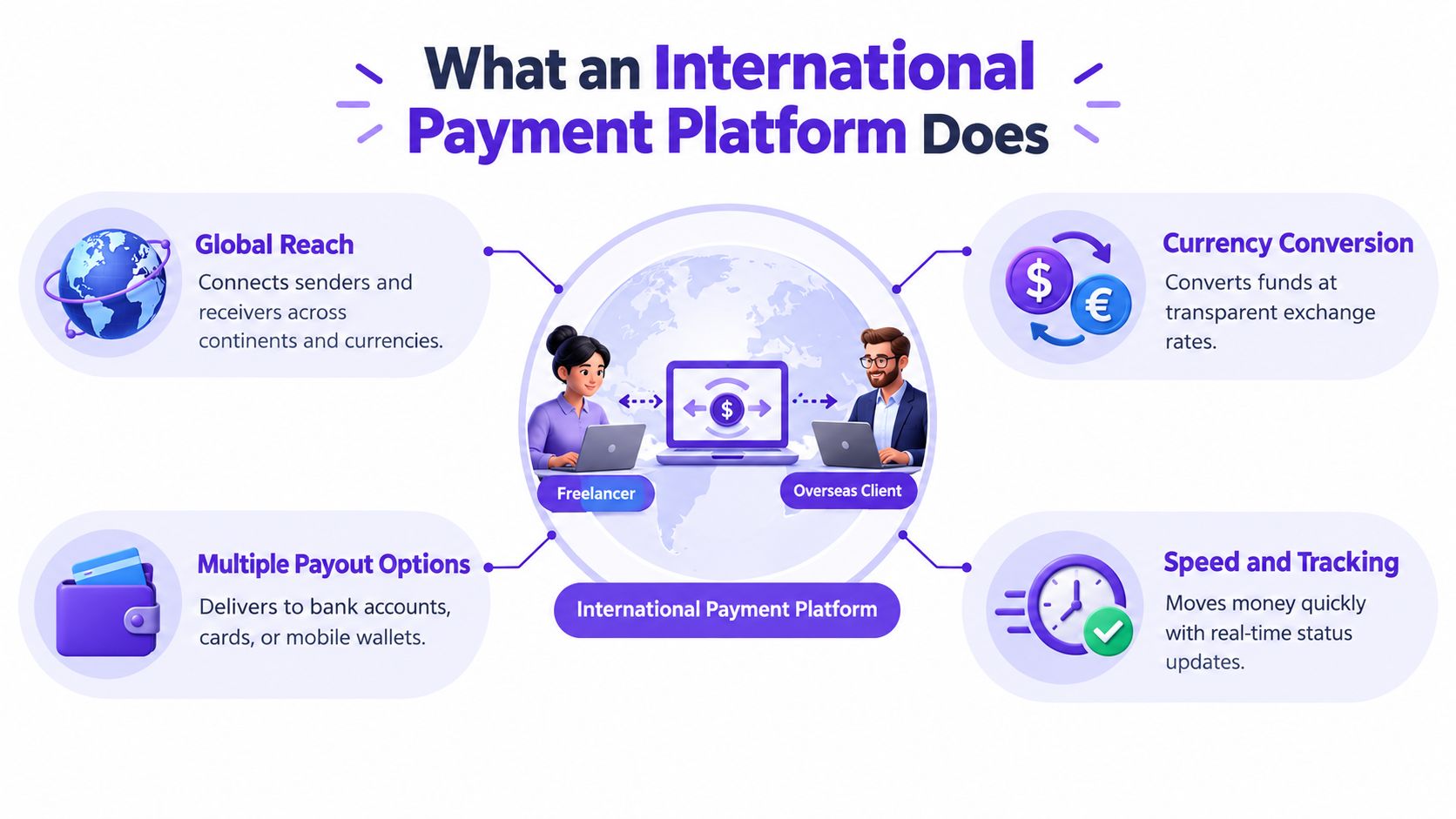
It's also useful to separate this from related tools. A bank can move money internationally, but a bank is still a deposit-taking institution first. A card network like Visa or Mastercard moves card payments, not the full remittance or payout journey on its own. A basic remittance shop may help with cash pickup, but modern platforms often do more, including digital funding, tracking, scheduled transfers, and multi-currency handling.
Practical rule: if a provider can only describe the front end of the transfer, ask how the rest of the journey works, especially conversion, payout, and exception handling.
The bigger picture matters too. One industry estimate put the cross-border payments market at about $208 trillion in 2025, with roughly $164 trillion in wholesale flows and $44 trillion in retail flows, plus a combined revenue pool of about $625 billion (FXC Intelligence). That scale is why these platforms matter for payroll, supplier payments, remittances, and treasury movement, not just consumer transfers.
How Cross-Border Payments Move
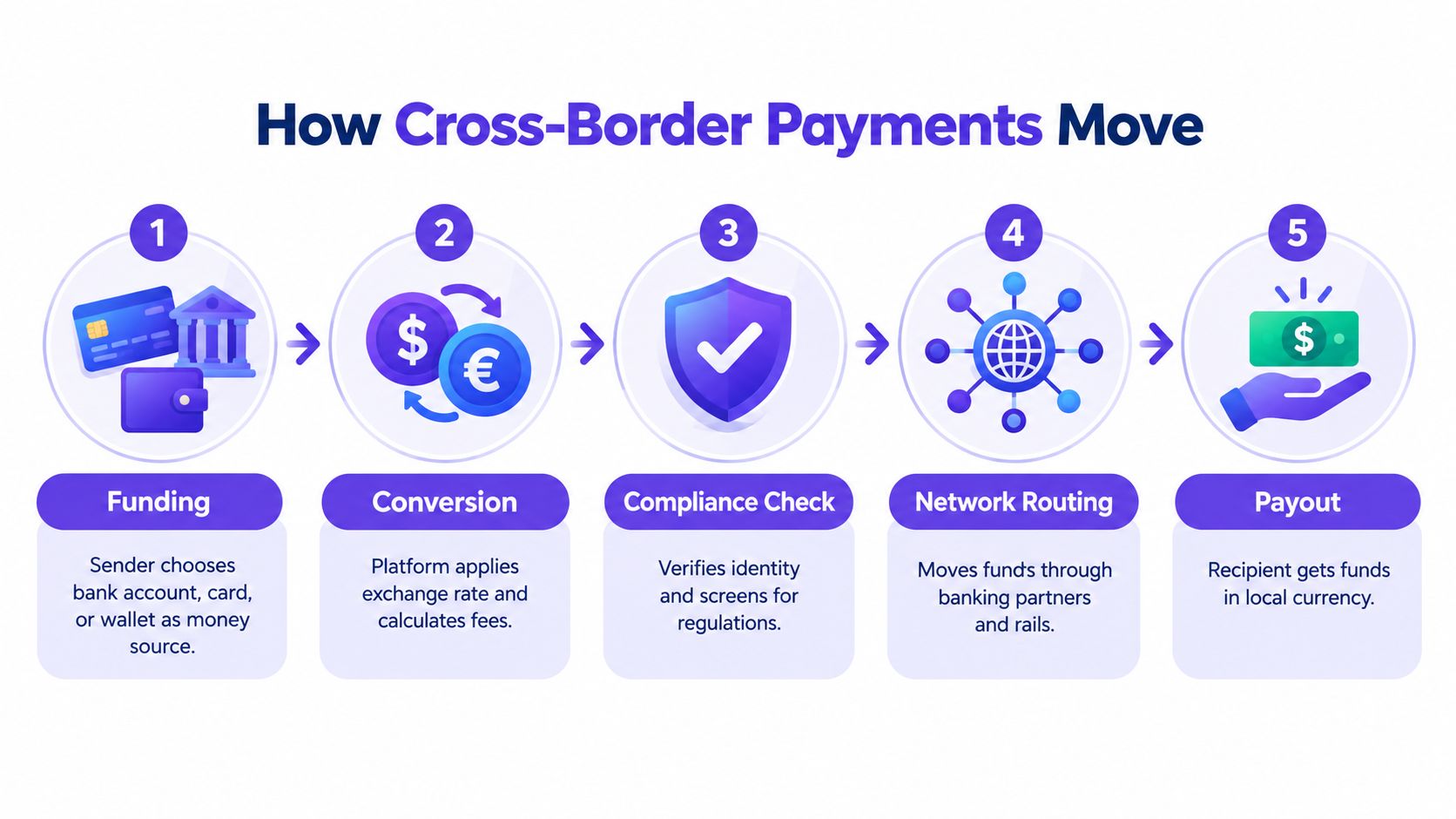
A transfer usually starts with funding. The sender chooses a bank account, debit card, credit card, wallet balance, or another supported source, and the platform checks whether that source is acceptable for the corridor in question. Some routes are built for speed but carry higher funding costs, while bank funding can be cheaper but slower to initiate.
The checks happen before money is released
Once the transfer is created, the platform runs compliance checks. That includes identity verification, sanctions screening, and transaction monitoring. These checks aren't decorative, they determine whether the transfer can proceed, whether it needs extra review, or whether the platform must reject it.
The exchange step comes next. The platform quotes a rate, applies fees or spread, and shows the sender what the recipient should get. Many people get confused, because the amount they send and the amount the recipient receives are not always the same after conversion, intermediary deductions, or payout-side charges.
Settlement is the part most users never see. The funds move through correspondent banks, local payment rails, or wallet-based infrastructure depending on the corridor and the provider's network design. If the route depends on a chain of banks, time zones, cut-off times, or weekend closures can slow the transfer. If the route uses local rails or prefunding, delivery can be much quicker.
The final stage is payout. The recipient receives funds in a bank account, mobile wallet, or cash pickup point, depending on what the platform and corridor support. That last leg is often where the user experience is won or lost, because a transfer isn't really complete until the money is usable on the receiving side.
This explanation of SWIFT transfer routing helps if you want a deeper look at one common settlement path.
A fast-looking transfer can still slow down at compliance or payout, so the real question is not “how fast is the app,” it's “how many hops does this corridor need?”
The reason this matters is visible in market data. The Financial Stability Board reported that in 2024 only 50.6% of wholesale payments over SWIFT completed the full settlement process within one hour, while 92% finished within one business day, and beneficiary-leg speed varied widely by region, from 24.7% within one hour in Africa to 81.8% in North America (FSB PDF). That variation is why the transfer journey matters more than a brand promise on the landing page.
Features, Funding Methods, and Pricing
A payment platform can look straightforward on the surface. Once you trace the full transfer journey, the choices start to matter. Funding method, wallet tools, payout options, and pricing each affect how much arrives, how quickly it settles, and how predictable the result feels.
Funding and wallet features
Bank transfers are familiar and often suit planned business payments. They are useful when a sender can wait for funds to clear before release. Debit cards can start a transfer faster, which helps when timing matters, though that convenience may come with a higher cost. Credit cards can add flexibility, but card issuer rules may limit use.
Wallet balances solve a different problem. They let a user hold funds ahead of time, keep multiple currencies in one place, and send repeat transfers without restarting the process each time. For a business, that can simplify recipient lists, transaction tracking, and recurring supplier or payroll payments. For families, it can make monthly support easier to coordinate because the money is already set aside.
Pricing is more than the fee badge
A low transfer fee does not always mean a low total cost. The exchange-rate spread matters because a platform can charge little upfront and still give the sender a weaker conversion rate. Intermediary deductions can also reduce what the recipient receives, especially on bank-to-bank routes with several institutions in the path.
| Components That Shape Transfer Cost | How It Works | Impact on Recipient |
|---|---|---|
| Transfer fee | A fixed or percentage charge added by the platform | Lowers the amount available to send or receive |
| Exchange-rate spread | The platform's rate differs from the market rate | Can reduce the final receipt even when the fee looks small |
| Intermediary deductions | Fees taken by banks or payout partners along the route | Recipient may get less than expected |
| Payout-side charges | The receiving institution deducts its own fee | Final amount can drop after the transfer appears complete |
The World Bank's remittance data shows that average sending costs still vary meaningfully across providers and transfer types, and digital channels tend to be cheaper than non-digital ones, though the gap is not always wide enough to ignore the full landed amount (World Bank Remittance Prices Worldwide). That is why a sender should compare what the recipient gets, not just the fee shown on the checkout screen.
A useful habit is to check the final recipient amount before funding the transfer. That single step often reveals difference between two platforms that look similar at first glance.
Why Speed and Cost Vary by Corridor
A corridor is a country-to-country route, and each one has its own banking partners, payout rails, compliance expectations, and local market structure. The same provider can feel near-instant on one route and slow on another because the path funds take is not the same.
Global remittance costs still vary widely by route and transfer type, as noted earlier. High-volume diaspora corridors usually benefit from stronger competition, local payout networks, and more established compliance workflows. Lower-volume routes often rely more on correspondent banking chains and manual review, which can increase both cost and delivery time.
What differs from one corridor to another
A corridor with strong mobile-money or wallet coverage often settles faster because the payout leg is local and direct. If the receiving country still depends on bank chains, the platform may need to pass funds through multiple institutions before they are available. Cut-off times, holidays, and time-zone gaps become part of the sender's experience.
Cost also changes by corridor because of foreign exchange margins, intermediary fees, liquidity sourcing, and AML review intensity. Some routes require more prefunded liquidity, which raises operating cost. Others face more compliance friction because of geography, regulation, or risk scoring.
The G20 and FSB benchmark for retail cross-border payments targets 75% credited within one hour and the remainder within one business day, but current public data show many use cases are still below that mark (ECB statement). That is why corridor-specific questions matter more than a generic “fast transfer” label.
A practical way to compare providers is to look at the full transfer journey, not just the promised send time. Ask what happens if the route needs bank conversion, whether the sender can fund instantly from the available methods, how the platform handles compliance checks, and what the recipient receives after payout-side deductions. Near-instant delivery also depends on the operational setup behind the scenes, including local payout access and the ability to move liquidity into the right place quickly.
| Corridor Factors That Affect Speed and Cost | Typical Settlement Rail | Average Delivery Time | Main Cost Drivers |
|---|---|---|---|
| Dense diaspora corridor | Local rails or wallet integrations | Often faster than bank-chain routes | FX spread, payout partner fees, liquidity cost |
| Bank-chain dependent corridor | Correspondent banking and SWIFT-style routing | Can take longer, especially across cut-offs | Intermediary fees, compliance reviews, routing hops |
| Wallet-heavy corridor | Mobile money or wallet-based settlement | Often quicker once funded | Wallet payout charges, funding method cost |
| Lower-volume or higher-risk corridor | Mixed rails with more manual review | More variable | Compliance intensity, fewer partners, liquidity sourcing |
How to Evaluate Security and Compliance
A platform can move money quickly and still be the wrong choice if its licensing, controls, or review process are weak. A transfer is only as dependable as the checks behind it, so start with the legal and operational basics before you send a large amount.
Start with licensing and identity controls
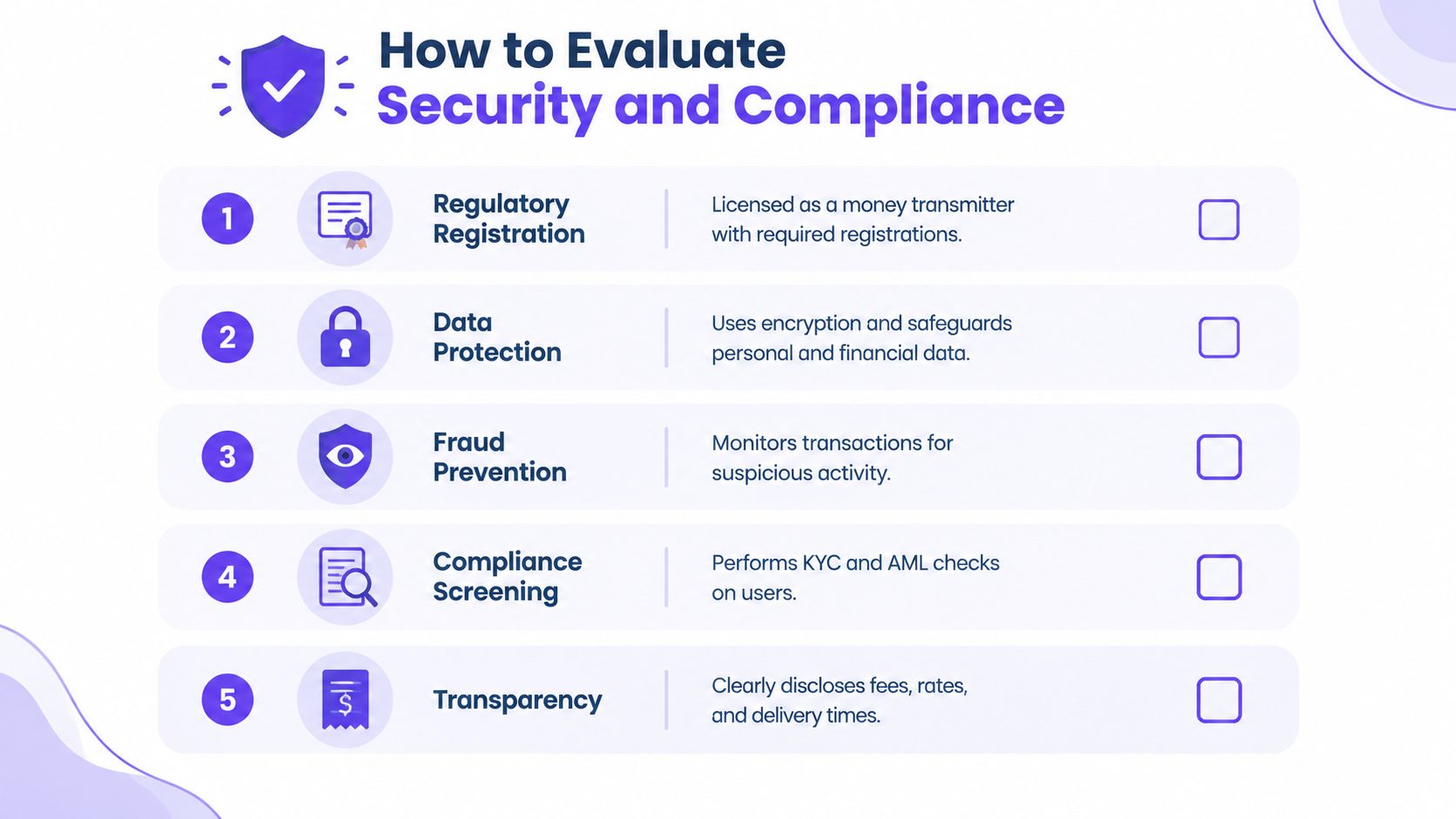
Look for registrations in the jurisdictions that matter to you. That may include money transmitter or e-money licensing, registration with FinCEN in the United States where applicable, oversight from the FCA in the UK, or FINTRAC registration in Canada. Verify the legal entity behind the brand, not only the app name.
KYC, AML screening, and sanctions checks should run at the transaction level, not only when an account is opened. OFAC and UN list screening matters because a compliant platform has to stop or review transfers that match restricted parties or suspicious patterns. Transaction monitoring should also flag unusual amounts, repeated retries, mismatched recipient details, or source-of-funds concerns.
Security should be visible, not vague
Encryption, segregation of client funds, two-factor authentication, and clear data protection policies are basic expectations. Support quality matters too, because a delayed transfer is easier to resolve when the provider has reachable support channels.
For a practical security benchmark outside money movement itself, the PCI DSS guidance for UK IT providers shows the level of discipline payment environments need when handling sensitive data. Cross-border transfers need the same mindset, because trust depends on process as much as on speed.
Compliance checks also affect the final receipt cost. A route that looks cheap at checkout can still end up more expensive if it triggers extra review, slower payout, or a weaker conversion path. For a broader view of how cross-border rules affect transfers, Africhange's international money transfer regulations overview is a useful reference point for seeing how a regulated platform explains its obligations across markets.
Quick checklist: confirm the license number on the regulator's website, identify the legal entity, review fund safeguarding, and test whether support responds before sending a large amount.
Real-World Platform Use Cases
A small online retailer paying a supplier abroad needs predictability more than anything else. The business has invoices, accounting entries, and maybe a monthly shipment schedule, so it cares about bank deposit options, batch transfers, scheduled payments, transparent FX, and documentation that makes reconciliation easier.
A migrant worker sending money home each month has a different priority set. That sender wants a simple mobile flow, low per-transfer friction, clear rate displays before confirmation, and a payout method the family can use without a trip across town. If the corridor is a high-volume diaspora route, wallet payout or bank deposit might be a better fit than cash pickup.
What the right features look like in practice
Platforms aimed at business payments often need business accounts, bulk upload, API access, and recurring scheduling. That helps finance teams reduce manual entry and keep transfer records tied to invoices or payroll runs. Platforms aimed at family support usually lean on mobile-first funding, saved recipients, and easy repeat sends.
The best choice depends on rhythm. A supplier payment that happens once a month has different needs from a personal transfer that happens every payday. If the user has to explain each payment to accounting or to a family member, the platform should make that explanation easier, not harder.
For teams trying to reduce repetitive payment work, the AI finance automation resource is a useful companion read because it shows how finance workflows can be structured around recurring approvals and exceptions rather than manual follow-up.
| Matching Platform Features to Real-World Needs | Primary Need | Key Platform Features | Watch-Outs |
|---|---|---|---|
| Small business supplier payment | Predictable settlement and clean records | Business account, scheduled transfers, transparent FX, invoice-friendly history | Avoid unclear landed cost or unsupported currencies |
| Monthly family support | Simple repeat sending and fast payout | Mobile funding, saved recipients, wallet or bank payout, delivery estimates | Don't assume “digital” means the total cost is low |
| Recurring contractor payments | Batch efficiency and documentation | Bulk upload, API access, recurring transfers, tracking | Check whether compliance review slows repeated sends |
| One-off urgent transfer | Speed and final receipt certainty | Instant funding where available, clear payout method, live tracking | Confirm corridor support before funding |
Where Africhange Fits
Africhange fits as a cross-border option for users moving money within its documented markets, not as a universal rail for every global corridor. It supports transfers from Canada, the US, the UK, EU member states, Nigeria, and Australia, and it also offers a digital wallet for holding and moving funds across those markets.
That matters because the platform's documented funding and payout design aligns with several of the pain points covered above. It supports funding via Interac e-Transfer, ACH or bank transfers, debit cards, and crypto wallets in the markets it serves, and it provides payout options that include bank deposit, mobile wallet, and cash pickup across its supported corridors. It also shows rate information before confirmation, which directly addresses final-receipt uncertainty.
Africhange's compliance footprint is also part of the evaluation. It is registered in Canada with FINTRAC as an MSB, licensed in Québec, authorised by the FCA in the UK, regulated by ASIC in Australia, licensed through its subsidiary in Nigeria as an IMTO by the CBN, and licensed as an IMTO in Ghana by the Bank of Ghana. Those registrations tell a reader more about the platform's operating posture than a marketing claim ever could.
The platform also offers a USD virtual account, which is relevant for users who need to receive USD payments directly, especially when local bank deposit paths are limited or inconvenient.
| Africhange at a Glance | Documented Offering | Reader Benefit |
|---|---|---|
| Funding methods | Interac e-Transfer, ACH or bank transfer, debit card, crypto wallets | More ways to start a transfer depending on country and cash-access preferences |
| Wallet | Multi-currency digital wallet | Hold and move funds across supported markets with less friction |
| Payouts | Bank deposit, mobile wallet, cash pickup | Match the recipient's actual access point |
| Compliance | Registrations in Canada, the UK, Australia, Nigeria, and Ghana | Gives the sender a clearer sense of regulatory coverage |
| USD receiving | USD virtual account | Lets users receive USD payments from anywhere in the world |
This USD account explainer is useful if you want to understand how that receiving flow works in practice.
Choose the Right Platform With Confidence
A good choice starts with the corridor, not the brand name. Check whether your country pair is supported, then calculate the full amount the recipient gets after fees and the exchange rate. After that, verify the platform's licensing in the sending and receiving markets, confirm the expected payout speed for that route, and test support before you move a large amount.
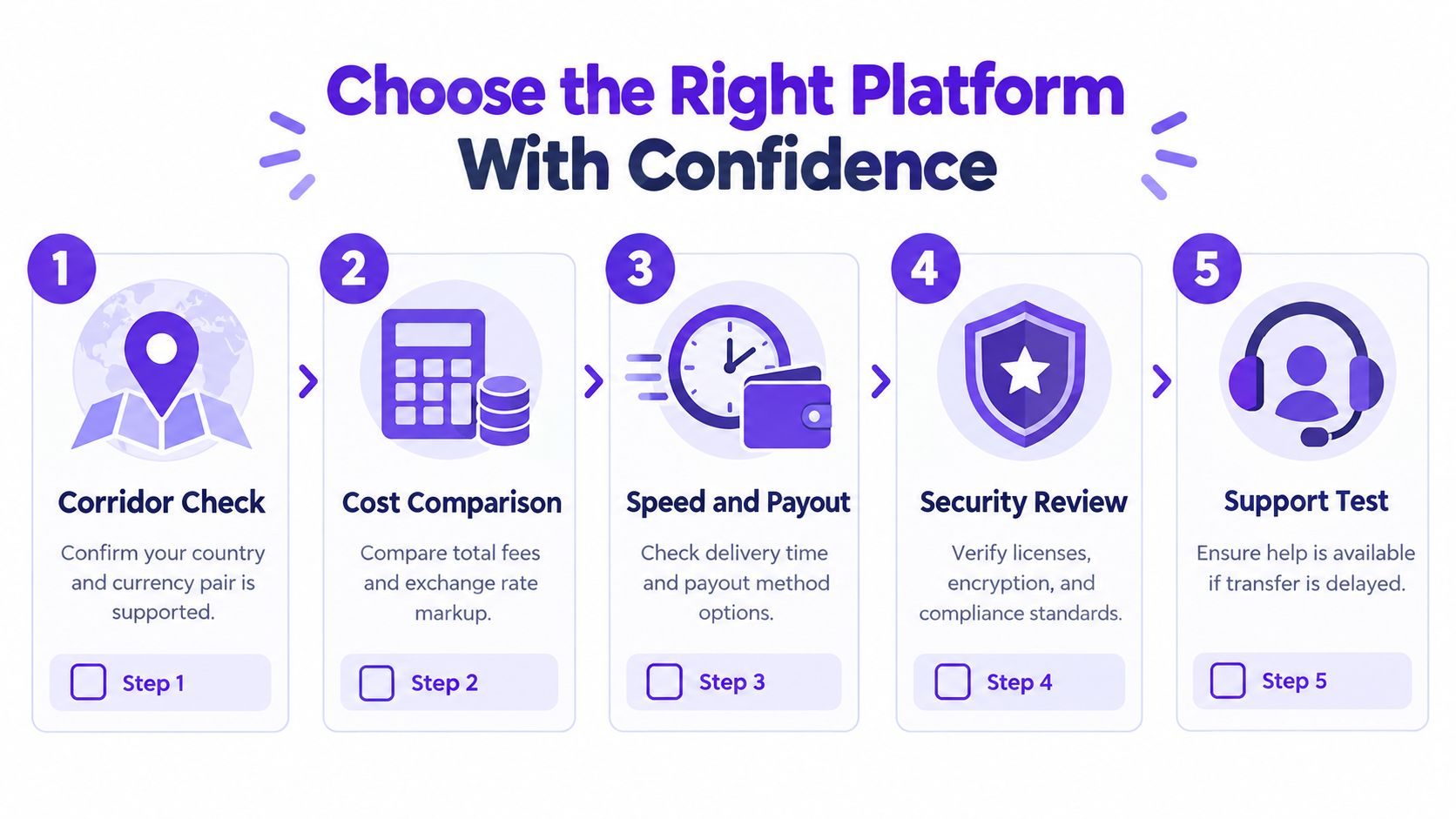
The right international payment platform is the one that matches your actual transfer pattern. If you send recurring support to family, you need final receipt certainty and simple funding. If you pay suppliers or contractors, you need corridor coverage, documentation, and predictable settlement. Africhange is one option for readers whose corridors and funding methods align with its documented markets and regulated setup, so visit Africhange to review its transfer flow, supported countries, and wallet features before you send your next payment.