
Money Transfer Ghana: Methods, Costs and Step-by-Step Guide

A nurse in East London is sending £450 to her mother in Madina on the last Friday of the month. The money has several jobs waiting for it, school costs, rent, and stock for the family provision shop. She isn't only asking which service has the lowest advertised fee. She needs to know how much will arrive, when it will arrive, and whether her mother can use it without another costly step.
That decision is harder than a simple bank transfer. The recipient may have a bank account, a mobile wallet, or neither. A cash pickup can solve an urgent problem quickly, while a wallet may be more convenient for regular household support and a bank deposit may suit rent or tuition. The exchange rate, payout cap, recipient details, and local charges can change the practical result.
Ghana received US$4.6 billion in remittances in 2023, following US$4.7 billion in 2022 and US$4.5 billion in 2021, according to World Bank migration and development reporting referenced by the Ghana National Chamber of Commerce. Remittances represented about 6.1% of Ghana's GDP in 2020, showing why this corridor matters to household finances and to the wider economy.
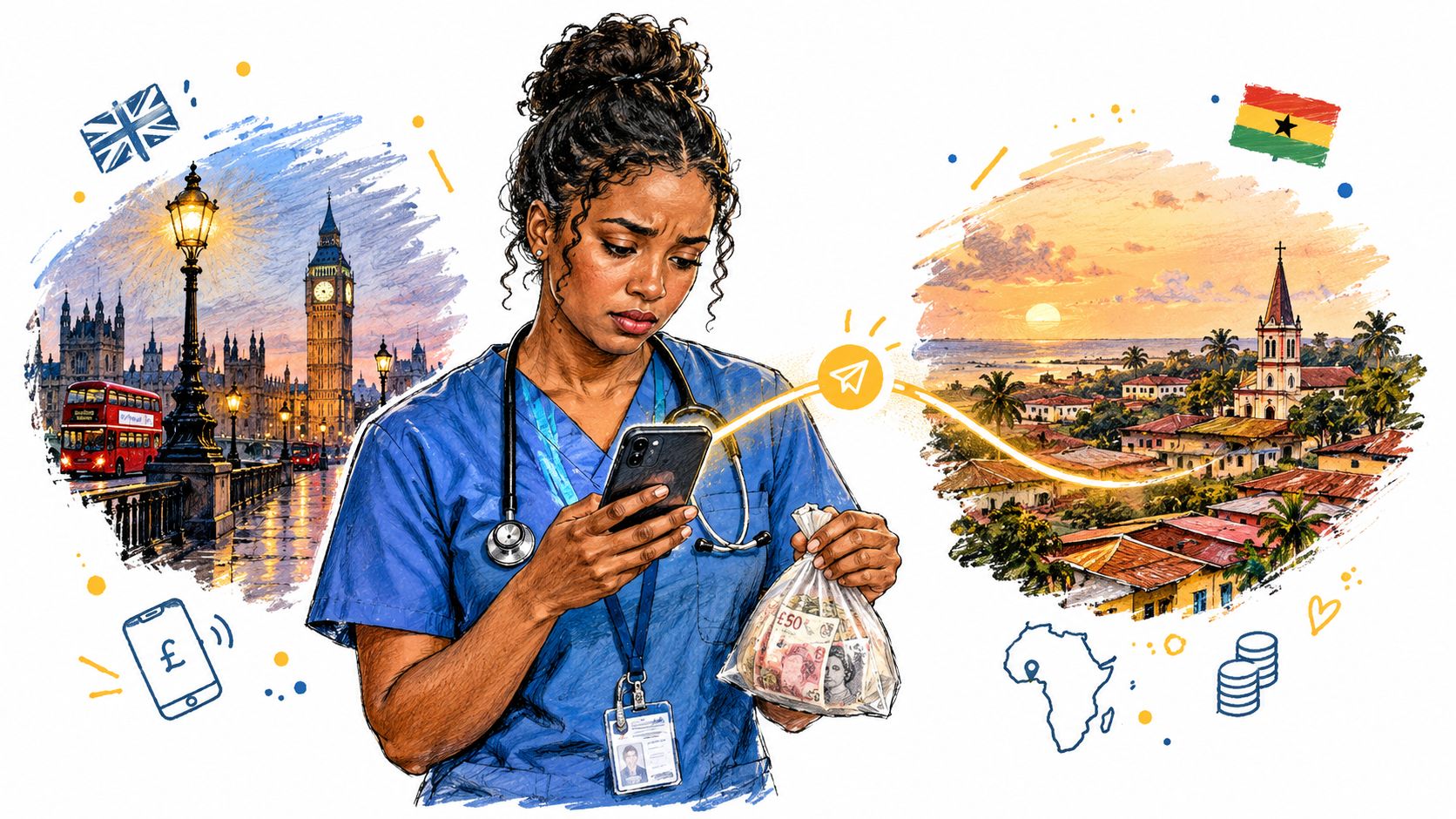
Table of Contents
- Why Sending Money to Ghana Matters Right Now
- How the Ghana Remittance Corridor Works
- Comparing Bank Deposit, Mobile Wallet and Cash Pickup
- Step-by-Step Africhange Transfer to Ghana
- Understanding the True Cost of Sending Money to Ghana
- Compliance, Limits and Recipient Requirements
- Common Questions About Money Transfer to Ghana
Why Sending Money to Ghana Matters Right Now
A fixed payday in London can collide with several urgent needs in Ghana. One recipient may be covering food and school expenses, while another needs funds for medical care, rent, transport, or shop inventory. The transfer's arrival time can matter as much as the amount sent, especially when a payment date or purchase cannot wait.
That pressure changes the decision. The useful question is: Which payout route gives the recipient the right amount with the fewest points of failure? A low advertised fee offers little value if the recipient waits for a bank batch, travels to a distant cash agent, or pays another charge to turn wallet balance into spendable cash.
Why the corridor carries serious financial weight
Ghana's remittance series reaches back to 1979, giving analysts a long record of cross-border household payments. Over time, these transfers have supported families, small businesses, and recipients without convenient access to conventional international banking.
The practical consequences appear at home. A delayed payment can force a missed bill, postpone a purchase, or create an unplanned trip to an agent. A weak exchange rate can also reduce the cedi amount available for its intended purpose, even when the transfer fee looks modest.
Practical rule: Decide what the recipient must do with the money before choosing how it should arrive.
Senders in the UK, US, Canada, Australia, and EU countries may face different funding methods, identity checks, processing schedules, and card or bank requirements. Ghana's receiving options create another set of trade-offs. A mobile wallet suits frequent daily spending and can avoid an agent visit. A bank deposit may fit rent, tuition, or other larger obligations where a formal account record helps. Cash pickup can solve an urgent need, but it depends on agent access, identification, and the recipient's ability to collect in person.
Africhange fits into this choice rather than replacing it. The sender should compare its available bank deposit, mobile wallet, and cash pickup routes by the quoted cedi amount, applicable fee, delivery speed, and payout cap before confirming a transfer. That comparison also reveals which route is practical for the recipient, not merely which option appears cheapest at checkout.
The rest of this guide treats bank deposit, mobile wallet, and cash pickup as competing payout surfaces. Each can win in a different situation. The right choice depends on the amount, the recipient's setup, required speed, available cap, and cedi amount delivered after relevant costs.
How the Ghana Remittance Corridor Works
A Ghana-bound transfer passes through three connected layers before the recipient receives cedis. The sender funds the transaction, the transfer operator checks and prices it, and a Ghana-based receiving partner completes the payout. That structure creates the practical choice between bank deposit, mobile wallet, and cash pickup.
- Funding side: The sender uses a bank account, card, wallet, or another approved payment method.
- Transfer operator: The operator verifies the transaction, applies its exchange-rate quote, runs compliance checks, and coordinates settlement.
- Ghana receiving partner: A bank, mobile-money provider, payment service provider, or cash agent delivers the funds.
The Bank of Ghana requires inward remittance activity to run through BoG-registered International Money Transfer Operators working with licensed banks, payment service providers, or other regulated financial institutions. The 2026 notice and the registration extension to 31 July 2026 are covered in the Ghana Broadcasting Corporation's report on the IMTO framework. The operator therefore works within an accountable institutional chain, rather than only moving money between two personal accounts.
Three rails, three operating outcomes
Bank deposit uses bank settlement and account-crediting processes. It suits rent, tuition, business payments, and other planned obligations because the recipient gets a formal account record. The trade-off is speed. Bank processing can take longer than a wallet transfer, especially when the receiving institution or funding route adds a review.
Mobile money sends funds to the recipient's registered telephone number and mobile-money network. It avoids collecting bank details and can be practical for daily spending or urgent household support. Wallet limits, recipient-detail matching, and any later cash-out charge still affect the final value.
Cash pickup routes the transfer to an agent and requires identity verification at collection. It can serve an unbanked recipient or someone who needs physical cash, but the recipient must reach a participating agent with acceptable identification. Travel, agent availability, local cash liquidity, and the transfer cap all become part of the cost and speed calculation.
The Bank of Ghana's inward-remittance guidelines allow licensed providers to terminate transfers into bank accounts, mobile-money wallets, or other BoG-approved electronic wallets. The same framework supports traceability, data collection, and monitoring for illegal operators. A compliant route therefore needs KYC records, transaction logs, and auditable settlement.
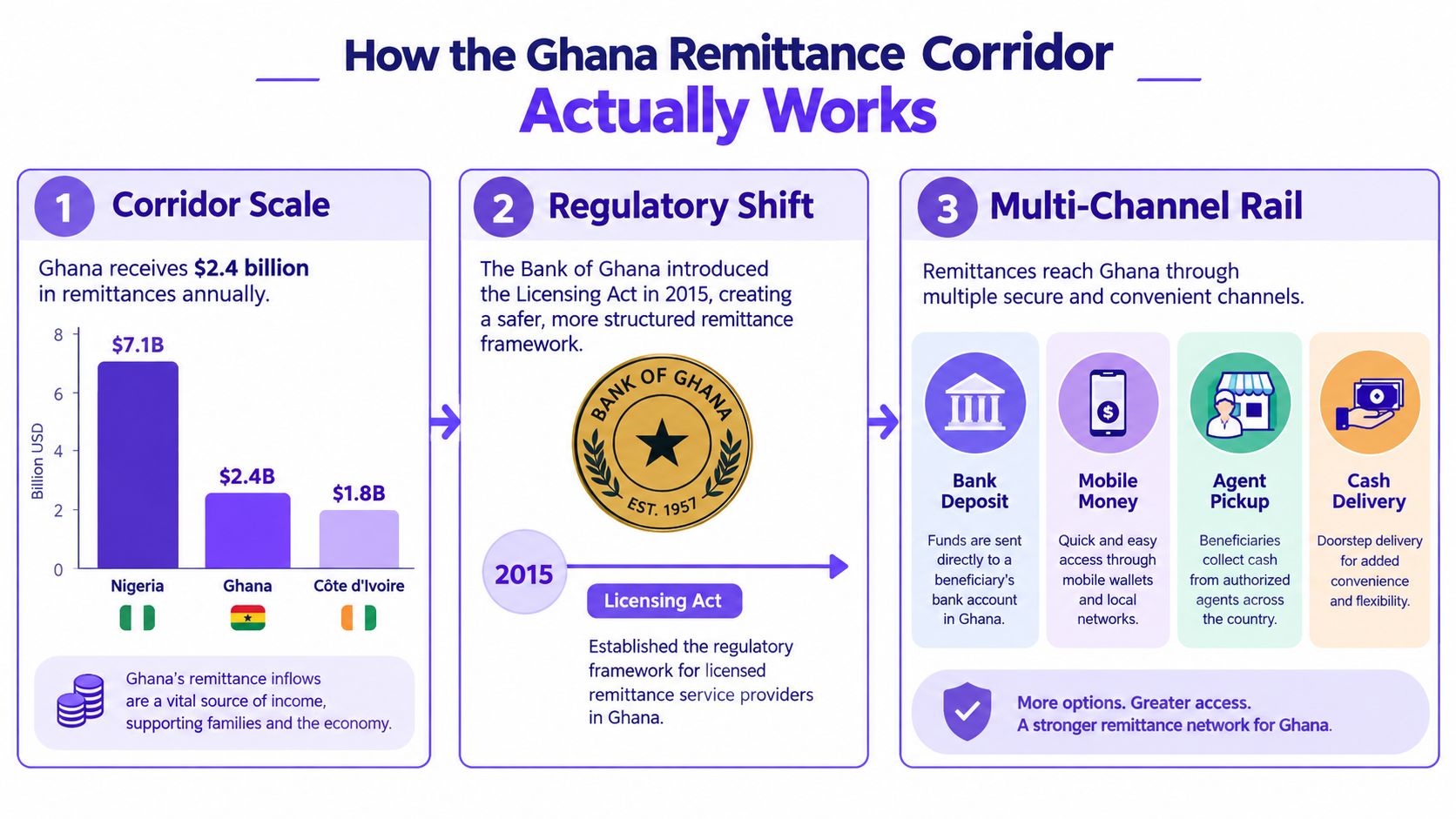
The payout surface changes more than the delivery method. It can change the cap, fee, timing, recipient effort, and cedi amount delivered. Compare the amount received, approval time, and recipient requirements before accepting a quote.
For a Nigeria-to-Ghana transfer, Africhange's guide to sending money to Ghana from Nigeria provides corridor-specific process guidance. Africhange should be assessed within the same comparison: choose the payout route that fits the recipient's account access, urgency, required amount, and ability to collect or cash out.
Comparing Bank Deposit, Mobile Wallet and Cash Pickup
A family member needs rent money today, a student needs tuition credited to an account, or an unbanked relative needs cash before the next market day. Each situation points to a different payout surface. Compare the amount received, transfer speed, provider cap, recipient effort, and total cost before choosing.
| Payout Method | Typical Speed | Fee on £400: What to Ask | Best Use Case | Recipient Setup Needed |
|---|---|---|---|---|
| Bank deposit | Often scheduled around bank processing | Ask for the all-in cedi amount after the transfer fee, exchange rate, and any receiving-bank charge | Rent, tuition, larger family support, business payments | Correct bank name, account number, recipient name, and sometimes branch or account type |
| Mobile wallet | Often near-instant when the wallet and checks are accepted | Ask for the cedi amount delivered to the wallet, then confirm any separate cash-out charge | Daily living money, quick family support, routine household spending | Active Ghanaian mobile-wallet number and matching recipient details |
| Cash pickup | Often available quickly through an agent when the transfer is approved | Ask for the final cedi cash amount after fees and the exchange-rate margin | Emergency support, unbanked recipients, rural access | Recipient identification, transfer reference, and access to a participating agent |
Bank deposit wins for planned obligations
Bank deposit suits payments that need a formal account credit or exceed a wallet provider's limit. Collect the exact account number and registered name before sending. A mismatch can delay review or cause the transfer to fail, even when the account itself is active.
The trade-off is timing. Bank settlement may follow processing windows, and an intermediary or receiving-bank charge can reduce the final amount. The headline transfer fee is only one part of the calculation. Compare the cedi credited to the account, not just the fee shown at checkout.
Mobile wallet wins for recurring household support
Mobile wallet is usually the practical choice when the recipient already uses MTN, Telecel, or AirtelTigo and needs funds without sharing bank details. The phone number routes the payment, and the recipient can spend the balance digitally before deciding whether to withdraw cash.
Wallet delivery can carry a lower cap than bank deposit. Western Union's Ghana send page, for example, lists bank-account transfers up to $5,000 and mobile-wallet transfers capped at $2,500 for the relevant route and conditions. The recipient may also pay a separate cash-out charge when converting the wallet balance into physical cedi. For recurring support, that withdrawal cost can matter more than a small difference in the sender's fee.
Cash pickup wins when access matters more than convenience
Cash pickup works for an unbanked recipient, an urgent small transfer, or someone who cannot reliably use a mobile wallet. It avoids bank-account details, but the recipient must travel to an agent, satisfy identification requirements, and collect during practical operating hours.
Use the final cash amount in cedi as the comparison point. A provider can show a modest fee while giving a weaker exchange rate, so ask how much the recipient will collect. Africhange should be judged by the same test, whether its Ghana route is used for a bank deposit, mobile wallet, or cash-access requirement. Refact's payment integration insights also explain why payment-method choice, customer experience, and reconciliation belong in the same operational review.
Step-by-Step Africhange Transfer to Ghana
Africhange's Ghana flow should be approached as a verified transfer order, not as a quick form where every field can be guessed. The first transaction usually takes more care because the platform needs to establish who is sending, where the funds come from, and who will receive them.
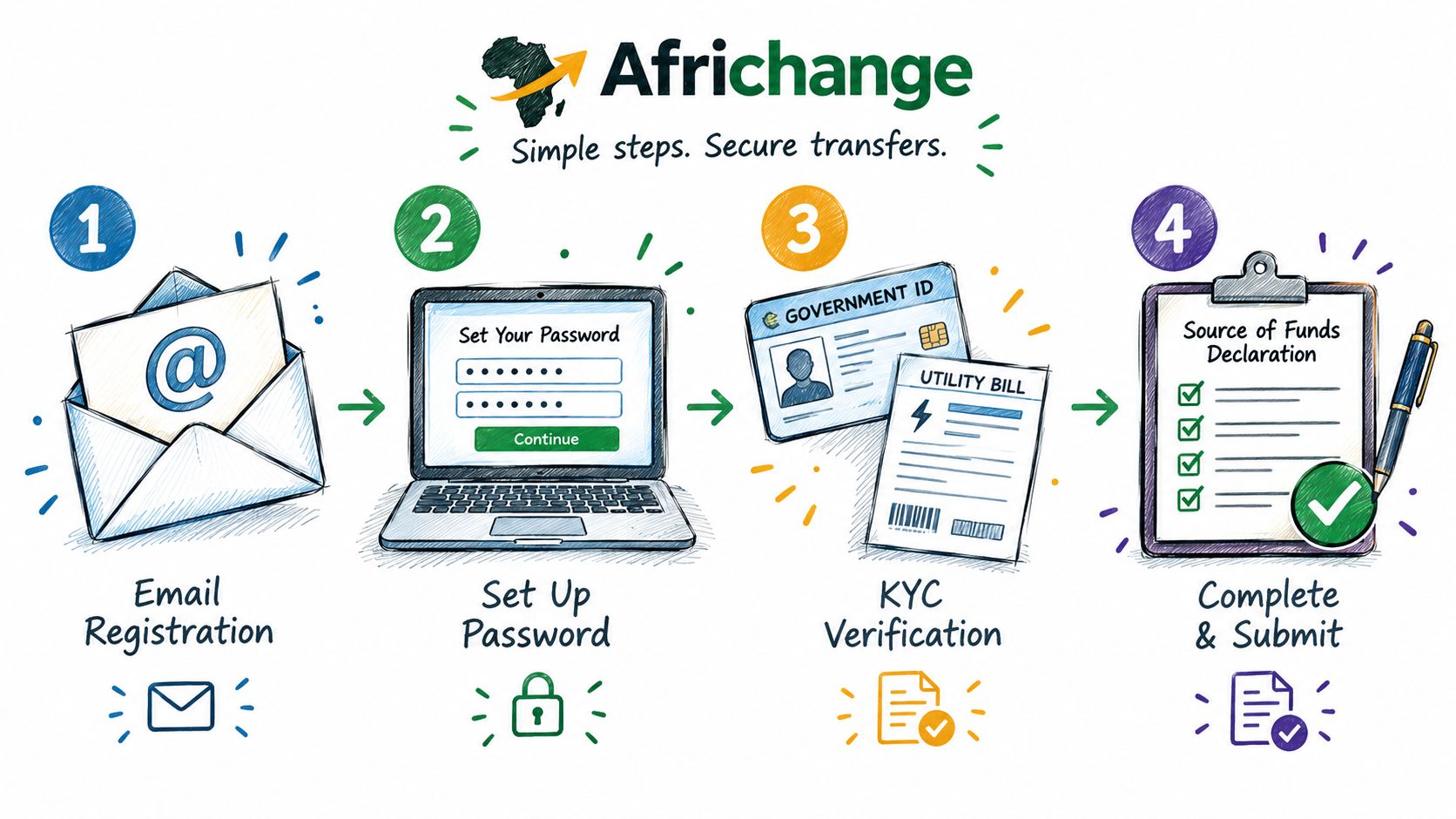
Create the account. Register with your email address and set a secure password. Use details that match your identity documents. An incorrect name at registration can create avoidable friction during verification.
Complete sender verification. Prepare a government-issued ID, proof of address, and the requested source-of-funds declaration. These checks protect the account and help the operator meet its compliance obligations. Upload clear, current documents rather than photographs with glare, cropped edges, or unreadable text.
Choose Ghana and the payout surface. Select either the recipient's Ghanaian mobile number linked to the selected wallet or the recipient's bank details. Check the network, account number, and name carefully. A valid phone number isn't enough if it belongs to a different wallet holder.
Review the name match. Africhange flags the relationship between sender and recipient details for review. This step catches common first-transfer problems, including spelling differences, abbreviated names, and details that don't match the receiving account or wallet registration.
Select funding. Available funding routes include card debit, bank transfer, and Apple Pay or Google Pay rails, subject to the sender's market and account eligibility. Choose the route you can complete reliably. A failed funding attempt can delay a transfer even when the Ghana payout information is correct.
Accept the quote. Review the send amount, exchange rate, fees, destination method, and expected recipient amount before submission. The exchange rate is locked at quote acceptance rather than being left entirely to the later payout moment.
Keep the confirmation record. After approval, the recipient may receive an SMS and a wallet push notification, while both parties should retain the reference ID. That reference is essential if the payout is delayed, rejected, or credited to the wrong destination.
A related explanation of mobile-money delivery is available in Africhange's article on sending money to Ghana and Kenya with mobile money.
The confirmation screen is where many senders stop paying attention. Don't. Compare the recipient's expected cedi amount with the purpose of the transfer, then check the recipient's notification once the payout is marked complete.
Understanding the True Cost of Sending Money to Ghana
The headline transfer fee is only one part of the price. A proper quote review considers the FX margin, local transfer taxation where applicable, wallet cash-out charges, receiving-bank deductions, and any corridor-specific surcharge.
The Ghana digital-payment overview from the U.S. International Trade Administration describes the Electronic Transfer Act and a 1.5% levy on many covered mobile-money and digital transfers above the exemption threshold. The exact treatment depends on the transaction and current rules, so the sender shouldn't assume that every payout receives identical treatment.
| Cost Component | Bank Deposit | Mobile Wallet | Cash Pickup |
|---|---|---|---|
| Transfer fee | May be shown separately or included in the quote | May be shown separately or included in the quote | Often reflects agent-based delivery and urgency |
| FX conversion | Can materially affect the cedi credited to the account | Can materially affect the wallet balance | Can materially affect the cash amount collected |
| Local levy exposure | Depends on the applicable transfer movement and threshold | May apply to covered electronic movements | Depends on the payout structure and subsequent use of funds |
| Recipient-side cost | Possible receiving-bank or account-related charge | Possible wallet cash-out charge at an agent | Travel and collection costs, plus any stated pickup charge |
| Main risk | A low fee paired with a weak rate or receiving deduction | A convenient wallet balance that costs more to withdraw | A fast payout with a less favorable all-in rate |
A sender comparing a GBP 500 transfer should record four figures before paying: the amount debited in pounds, the explicit fee, the exchange rate used, and the exact cedi amount expected at the destination. Don't fill the table with guessed values. Quotes change by sender market, funding route, recipient method, and transaction review.
The phrase “no hidden fees” can still leave a recipient with less than expected if the quoted FX rate is less competitive or if the recipient later pays to withdraw wallet funds. A transfer platform may disclose its own fee clearly while the recipient's next transaction creates another cost outside the original send order.
The useful number is the final cedi amount delivered and usable, not the fee displayed in isolation.
For regular family support, compare the same send amount across all three payout surfaces at the same time. For a business payment, also consider whether the recipient needs an account record, a predictable settlement trail, or immediate access to working capital.
Compliance, Limits and Recipient Requirements
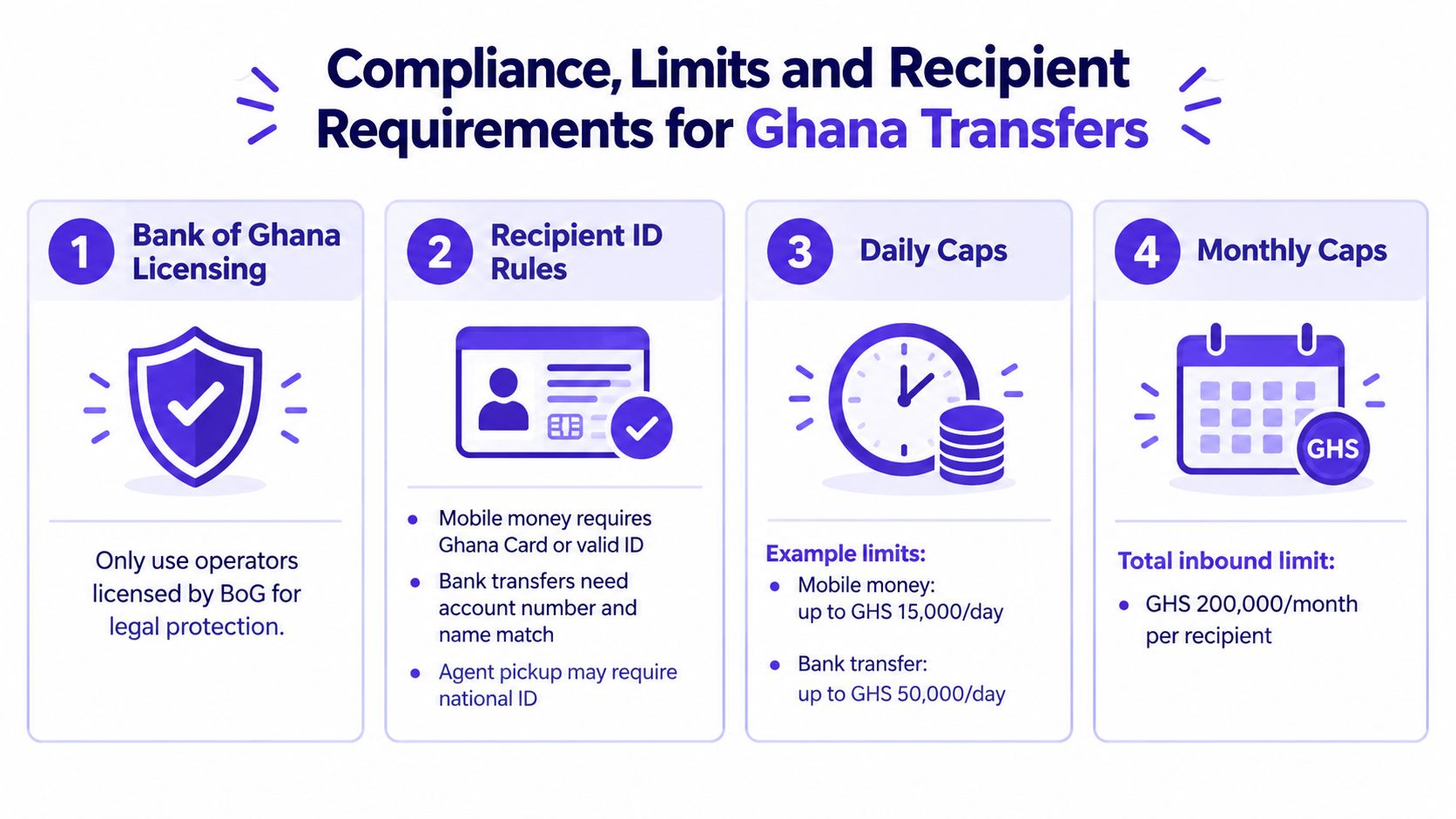
A transfer can clear funding and still fail at payout if the sender identity, recipient details, or route do not align. Use a regulated operator, confirm that the Ghanaian bank, wallet, or cash-pickup partner is supported, and keep the transaction record from quote to delivery. Ghana's rules place oversight and recordkeeping obligations on approved remittance channels, so the provider's verification questions are part of the payment process, not optional paperwork.
Prepare the sender file before the first payment
Keep your passport or national ID, recent proof of address, and source-of-funds information ready. An operator may request more evidence when the amount, funding method, payment pattern, or relationship with the recipient calls for enhanced review. Giving incomplete or inconsistent answers can delay a transfer that otherwise meets the route requirements.
The recipient must use the exact name registered with the bank or mobile wallet. For cash pickup, that person must also pass the agent's identification check. Do not enter a nickname, informal spelling, or another person's account details for convenience.
Treat limits as route-specific
A bank deposit, mobile wallet, and cash pickup can each have different caps and review rules. Limits may vary with verification status, funding source, recipient profile, currency, and the operator's compliance checks. Africhange's overview of international money transfer regulations offers broader context, but the live limit shown for your selected route controls the transaction.
Check the quote and permitted amount before funding a large payment. If the route cannot accept the full value, do not split it blindly. Ask support whether staged payments are allowed and whether repeated transfers could prompt another review.
Recovering a failed or delayed transfer
Common failure points include an incorrect wallet number, a name mismatch, unsupported bank details, failed sender verification, a reversed funding payment, or an outage at the receiving partner. Save the reference ID, confirmation screenshots, payment evidence, and recipient notifications.
If the status says complete but the recipient has no funds, contact the operator through its official support channel and request a trace. Wait for the first transaction's status to be resolved before sending another payment.
Teams that build payment workflows can enforce audit trails in pull requests, applying the same discipline to compliance records. Keep the quote, verification messages, funding receipt, and payout reference together so support can reconstruct the transaction quickly.
Common Questions About Money Transfer to Ghana
How long does a transfer take on a Tuesday or Sunday?
A mobile-wallet payout can be very fast when the sender is verified, funding clears, and the Ghanaian wallet details pass validation. A bank deposit may follow the receiving bank's processing schedule, so a Tuesday payment can behave differently from a Sunday payment. Cash pickup depends on approval, agent availability, and the recipient's ability to collect.
Africhange describes near-instant delivery and access outside traditional banking hours as part of its service offering, but the actual result still depends on the selected rail, verification, funding method, and receiving partner. Treat the live quote and status screen as the operational source of truth.
What is the maximum amount a fully verified sender can send?
There isn't one universal ceiling for every sender, recipient, currency, and payout method. A fully verified account may access a different limit from an account with only basic verification, while a wallet can have a lower limit than a bank route. Check the amount displayed after selecting Ghana and the payout method instead of relying on a generic maximum.
Does the recipient pay to receive the money?
The sender may pay the transfer fee, but the recipient can still face a cost later. Wallet cash-out charges, receiving-bank deductions, local transfer taxes, and travel to a cash agent can reduce the practical value of the payment. Ask whether the recipient needs a wallet balance or physical cash before choosing the route.
Can the exchange rate change after the quote?
It can change before a quote is accepted. Once the operator locks the rate at quote acceptance, the agreed conversion should govern that order, subject to the transaction's terms and any review or funding issue. Always record the quoted send amount, rate, and expected cedi delivery.
What does a first-time sender need for a larger transfer?
Prepare government identification, proof of address, source-of-funds information, and complete recipient details. A larger or unusual first transaction may receive enhanced review, so upload readable documents and allow time for questions before a rent, tuition, or business deadline.
The safest routine is simple: verify the recipient's details, compare the final cedi amount across payout methods, confirm the route's live limit, and keep the reference ID until the beneficiary confirms access.
Africhange supports transfers to Ghana through bank-account and mobile-money payout options, with quote review, transfer tracking, and several funding routes available by market. Compare the live payout amount and delivery method for your recipient, then visit Africhange to start a Ghana transfer with the details ready.