
ACH vs Wire Transfer: Speed, Cost and Which to Choose

Your supplier wants confirmation before releasing an order, or your family needs money for a bill that can't wait. Your banking app offers ACH and wire transfer, but the faster-looking option costs more, and neither button tells you exactly when the recipient can spend the money.
The useful ACH vs wire transfer comparison starts with that deadline. Choose the method that gets usable funds to the recipient on time, at an acceptable total cost, without taking settlement risk you can't afford.
Table of Contents
- ACH vs Wire Transfer at a Glance
- How Fast Each Rail Reaches the Recipient
- What Each Rail Really Costs Beyond the Fee
- Which Rail to Use for Each Payment
- Domestic Payments vs International Transfers
- What Happens If a Payment Goes Wrong
ACH vs Wire Transfer at a Glance
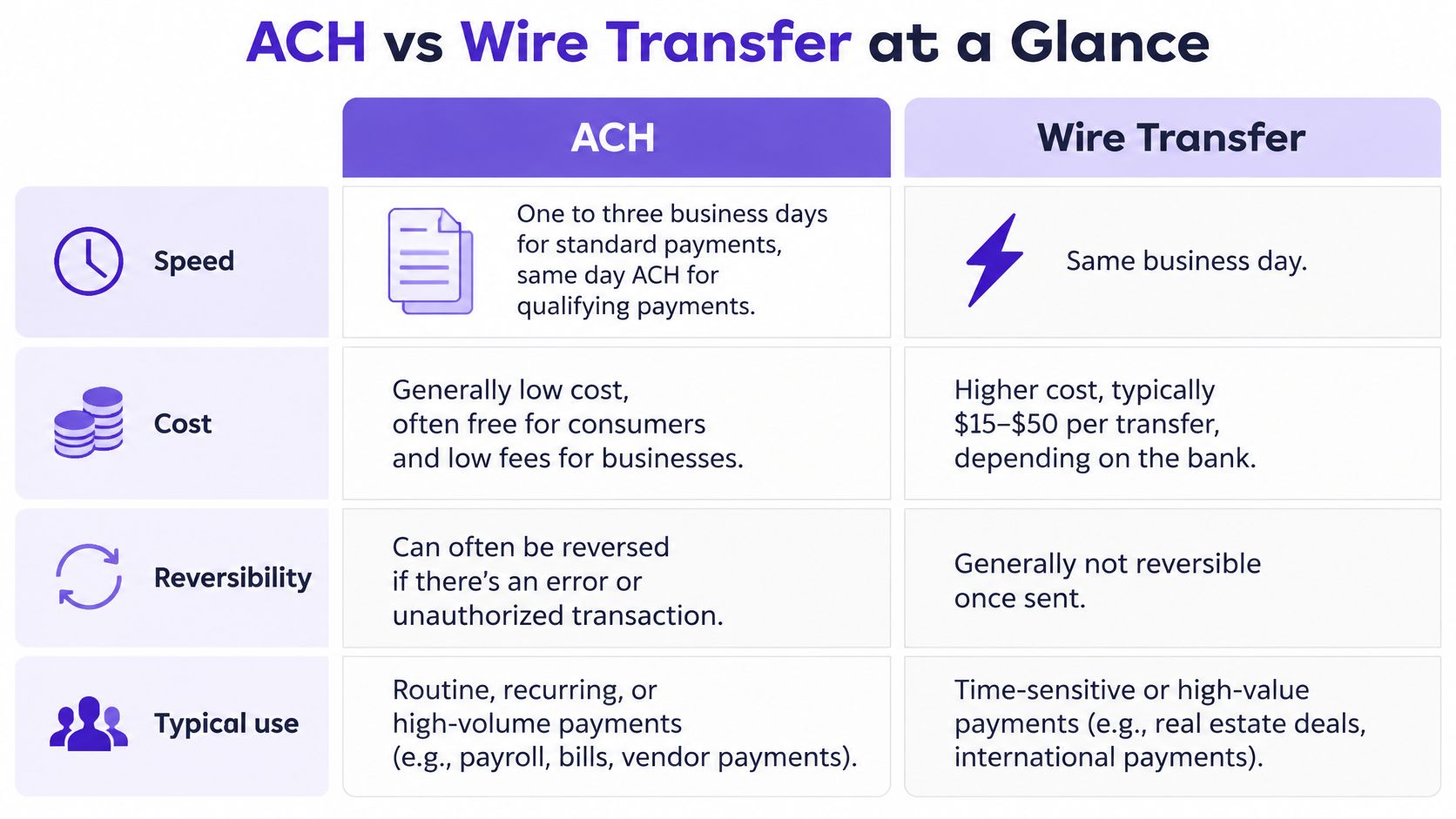
| Factor | ACH | Wire transfer |
|---|---|---|
| Typical speed | Scheduled processing; Same Day ACH for qualifying payments submitted before cutoff | Real-time Fedwire settlement after acceptance; recipient posting can take longer |
| Typical sender cost | Lower-cost option; account pricing determines per-item and service charges | Bank's outgoing-wire tariff, with possible additional international charges |
| Availability | Batch windows on business days, with weekend and holiday gaps | Fedwire business days, excluding Federal Reserve holidays |
| Settlement finality | Returns and qualifying reversals are possible within applicable windows | Fedwire settlement is final and irrevocable at the applicable acceptance point |
| Typical amount | Routine, recurring, generally lower-value payments | High-value, time-critical payments |
| Reach | Primarily domestic, with supported cross-border arrangements | Domestic and international, including correspondent-bank routes |
ACH is built for economical, high-volume account-to-account payments. Wires prioritize individual processing and final settlement, making them useful when the amount or deadline justifies the extra expense.
ACH stands for Automated Clearing House. Employers use it to push payroll into employees' accounts, while authorized billers can use ACH debits to collect recurring payments. That ability to handle scheduled credits and collections makes ACH useful for finance teams managing predictable cash flows.
The scale reflects that role: the ACH Network processed 33.6 billion payments worth $86.2 trillion in 2024, according to Nacha's annual ACH Network infographic. Those are ACH Network totals, not a promise about any bank's processing time or customer limits.
Read the table as a starting point
A wire isn't automatically the better choice because the invoice is important. If the supplier accepts a scheduled payment and you've allowed enough processing time, ACH can meet the obligation without paying for unnecessary urgency.
Likewise, choosing ACH purely to save the sending fee can backfire when a delayed payment stops a shipment. Fees are bank-specific, not universal prices, so compare your actual account tariff rather than assuming every ACH payment is free or every wire has the same charge.
Practical rule: Establish the recipient's usable-funds deadline before selecting the payment method.
How Fast Each Rail Reaches the Recipient
A transfer has more than a departure time. Your bank can accept an instruction without sending the payment immediately, and the receiving bank can receive funds before making them available to its customer.
For an ordinary bank-to-bank payment, track these stages:
- Instruction accepted: Your bank has received the request, but approval or processing may still be outstanding.
- Funds sent or rail-confirmed: The bank has released the payment into the relevant system and can provide its status.
- Funds usable: The recipient can withdraw, spend, or apply the money to the invoice.
ACH timing follows processing windows
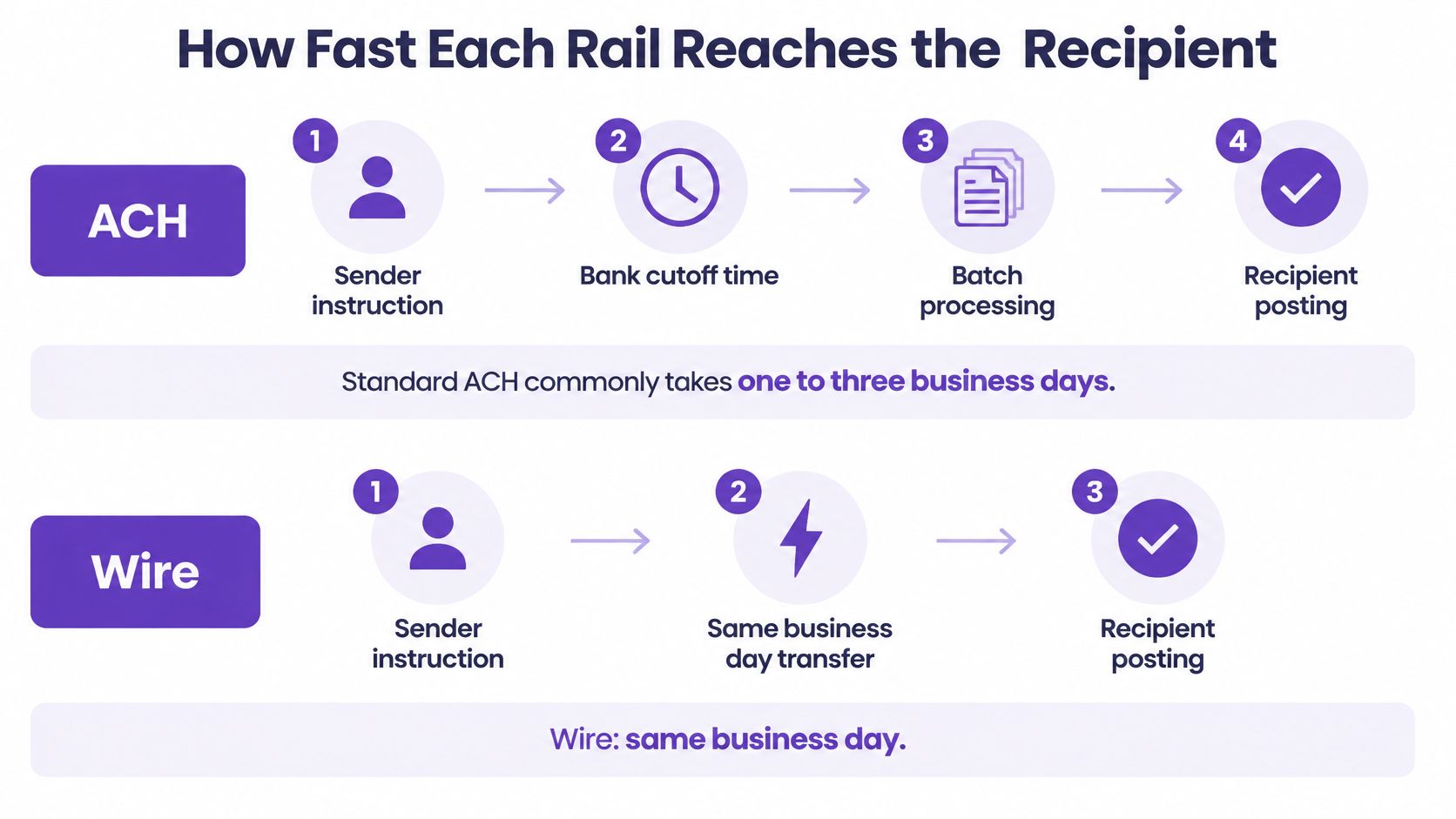
An ACH instruction moves through the originating bank's submission process, a scheduled clearing window, and the receiving bank's posting process. The selected service level matters, but so do the bank's own cutoff and your payment's eligibility.
Same Day ACH is therefore a scheduling option, not an instant-payment promise. If your finance team finishes approval after the bank's submission deadline, selecting that service won't restore a processing window you've missed.
Wires follow a different settlement process. The Federal Reserve's Fedwire Funds Service overview describes real-time gross settlement and a standard business schedule running Monday through Friday, excluding designated holidays, with online service generally available from 9:00 p.m. Eastern on the preceding calendar day until 6:30 p.m. Eastern.
Your bank's customer cutoff may be earlier than the network's closing time. Compliance checks, incomplete instructions, or additional authorization can also prevent a requested wire from entering the system when you expect.
The same Friday request can produce different results
Say you approve a supplier payment late on Friday afternoon. Your bank has already closed its applicable ACH submission window, but its wire desk is still accepting instructions.
The ACH payment waits for the next eligible processing opportunity. The wire could settle that business day if the bank completes its checks and releases it in time, although the supplier still needs its own bank to post the funds.
Change the scenario slightly and the advantage disappears. If the wire cutoff has also passed, paying the outgoing-wire fee doesn't create an open processing window.
Before promising a payment date, confirm the sending bank's cutoff, the relevant time zone, and the recipient bank's posting expectations. Ask for a usable-funds estimate, not just confirmation that your instruction will be accepted.
What Each Rail Really Costs Beyond the Fee
The fee displayed beside the transfer button is only part of the expense. A sensible comparison includes what leaves your account, what reaches the recipient, and what happens if the payment arrives late.
For ACH, business-account pricing may include per-item charges, file-submission charges, or an additional charge for an expedited service. A returned entry can create another fee and require staff to investigate, correct the instructions, and submit the payment again.
Prefunding also has a cost. Money committed to a payroll batch or transfer balance isn't available for another obligation, even when the processing charge itself is small.
Compare the complete quote
International wires require particular care because several parties can affect the final amount.
- Outgoing fee: Your bank charges for initiating the wire.
- Incoming fee: The recipient's bank may charge for receiving it.
- Intermediary deductions: Correspondent banks may deduct charges along the route.
- Currency conversion: The offered exchange rate can include a margin that matters more than the visible transfer fee.
A quote with a low sending fee can still deliver less local currency than a competing quote with a higher fee. When evaluating an international payment platform, compare the recipient's net proceeds for the same total sender outlay.
For a practical comparison, request quotes close together, using the same destination currency and funding method. Record the amount debited, any separately charged fees, and the recipient amount, then check whether that recipient amount is guaranteed or still subject to deductions.
Include the cost of missing the deadline
A cheaper payment isn't cheaper if the supplier adds a late charge or withholds materials your team needs. Conversely, a wire fee buys little value when the recipient won't process the invoice until its next accounts-receivable run.
Compare the recipient's net amount and usable-funds date, not the advertised sending fee alone.
Finance teams should keep a payment-cost worksheet with separate fields for bank charges, conversion cost, deductions, and exception handling. That makes it easier to distinguish an expensive rail from an avoidable rush caused by late internal approval.
Which Rail to Use for Each Payment
| Payment | Best rail | Why it fits | Watch for |
|---|---|---|---|
| Payroll | ACH | Batch processing supports many employees economically | Prefunding requirements and Same Day ACH cutoffs |
| Routine supplier invoice | ACH | Efficient for repeat vendors and scheduled obligations | Incorrect bank details and returned entries |
| Recurring bills or subscriptions | ACH | Supports authorized automated collection | Returns for insufficient funds |
| Real estate closing or large one-off deal | Wire | Final settlement for a high-value transaction | Fraudulent changed instructions and bank cutoffs |
| Urgent supplier payment with penalty deadline | Wire | Final settlement when the deadline requires it | A missed cutoff or receiving-bank review |
| Emergency support for family abroad | Wire or cross-border provider | Can fit urgent delivery needs when the route supports them | Intermediary deductions and local payout availability |
Read each row by deadline first, amount second, and finality third. The payment label alone doesn't settle the choice: a routine supplier invoice can become urgent, while a large payment can still be scheduled well in advance.
Run a deadline-first checklist
- Can the recipient wait for the applicable ACH window? If yes, start with ACH. If not, establish whether a wire can reach the recipient before the deadline.
- Does the payment recur or arrive in a batch? Payroll, subscriptions, and repeat supplier payments favor a scheduled workflow rather than repeated manual wire entry.
- Does the recipient require final settlement? A closing agent or treasury team may need more than an account balance that appears available.
- Is a weekend or holiday inside the delivery window? Include the calendars of the sender, processing institutions, and recipient.
- Is there a separate international payout leg? Confirm how the beneficiary receives the money rather than treating funding confirmation as completed delivery.
Businesses increasingly use both standard and expedited ACH rather than treating wires as the only alternative to slow processing. Nacha's 2024 Business Payments Study found that 60% of surveyed businesses used standard ACH in 2024, while 56% used Same Day ACH.
The middle ground matters. The Atlanta Fed's discussion of Federal Reserve payments-study findings reports annual growth in Same Day ACH credit value of 21% from 2018 through 2021. That expanded option makes a simple slow-versus-fast ranking less useful than checking the actual processing opportunity.
Know when each choice is wrong
ACH is the wrong choice when you can't tolerate uncertainty before an irreversible outgoing payment. For example, don't collect a new customer's funding and immediately commit a final supplier payout without an approved policy for the collection risk.
It's also unsuitable when the recipient requires a wire as a condition of the transaction. Confirm those instructions before the due date rather than assuming any electronic payment will satisfy the agreement.
A wire is the wrong choice for an ordinary recurring payment when it adds cost without improving the outcome. It's also a poor response to an unverified email demanding an urgent change of bank account. Urgency should trigger stronger verification, not a faster approval bypass.
A hard same-day deadline doesn't always require a wire. Eligible Same Day ACH can fit when the submission window remains open, the receiving arrangement supports the deadline, and irrevocable settlement isn't a requirement.
For overseas payments, use the same checklist when choosing an online money transfer platform. Compare destination coverage, recipient payout method, transaction visibility, and the full quote rather than selecting by funding method alone.
Before submission, confirm the bank's cutoff, verify beneficiary details through a trusted phone number, and have the approver check the payment against the table. A second review should test whether the selected rail meets the actual obligation, not merely whether the account number was entered twice.
Domestic Payments vs International Transfers
The funding rail and the payout rail are separate decisions. A sender can fund a cross-border service through a domestic bank transfer while the recipient receives a local-currency payment through a different banking system.
ACH primarily serves the United States. It isn't the name for every bank transfer made in Canada, the UK, Europe, or Australia, even when the customer experience looks similar.
International wires commonly use SWIFT messages and correspondent-bank relationships. SWIFT carries payment instructions; the banks involved arrange the movement and settlement of funds. This distinction helps explain why a sent message doesn't necessarily mean the beneficiary has received spendable money, as our explanation of how a SWIFT transfer works describes.
A Canadian business paying a Nigerian contractor
Say a Canadian business owes a contractor in Nigeria and agrees to pay in naira. The business funds a cross-border transfer using an available Canadian bank-transfer method, and the provider arranges the contractor's local payout.
The contractor's useful comparison is the naira amount received and when it becomes available. Whether the sender's initial funding looked like a conventional bank payment matters less than whether the complete route meets the contractor's needs.
At Africhange, we display the exchange rate and the amount the recipient will receive before the customer completes a transfer, and we have no hidden fees. Our wallet also lets users store funds and fund it in advance to send money faster.
That wallet is a funding convenience, not a reason to ignore the destination's payout requirements. Match the recipient's account name and details carefully, and check the transaction preview before authorizing the payment.
Collect the right banking details
The information required changes with the route:
- US ACH payment: Obtain the recipient's routing number, account number, account type, and matching account-holder details.
- International wire: Obtain the beneficiary's name, bank details, SWIFT/BIC, and IBAN or account number as applicable, plus intermediary instructions when required.
- Local payout through a provider: Use the beneficiary fields requested for that destination rather than assuming international-wire details are necessary.
Cross-border ACH arrangements exist, but support isn't universal. Confirm that the particular bank or service supports the destination rather than assuming a domestic ACH instruction can reach any foreign account.
For personal transfers, Fintrack's guide to sending rent or family support overseas provides additional context for comparing app-based options. Apply the same final check to any route: confirm the recipient's currency, exact amount, and expected availability before completing the payment.
What Happens If a Payment Goes Wrong
A wire isn't automatically safer because it settles faster. Finality reduces settlement uncertainty for the receiving institution, but it also makes a mistaken or fraudulent instruction much harder for the sender to recover.
The Federal Reserve's Fedwire core-principles assessment explains the service's final and irrevocable settlement model. That protection concerns settlement between participants, not a guarantee that the sender selected the right beneficiary.
Separate returns from recovery
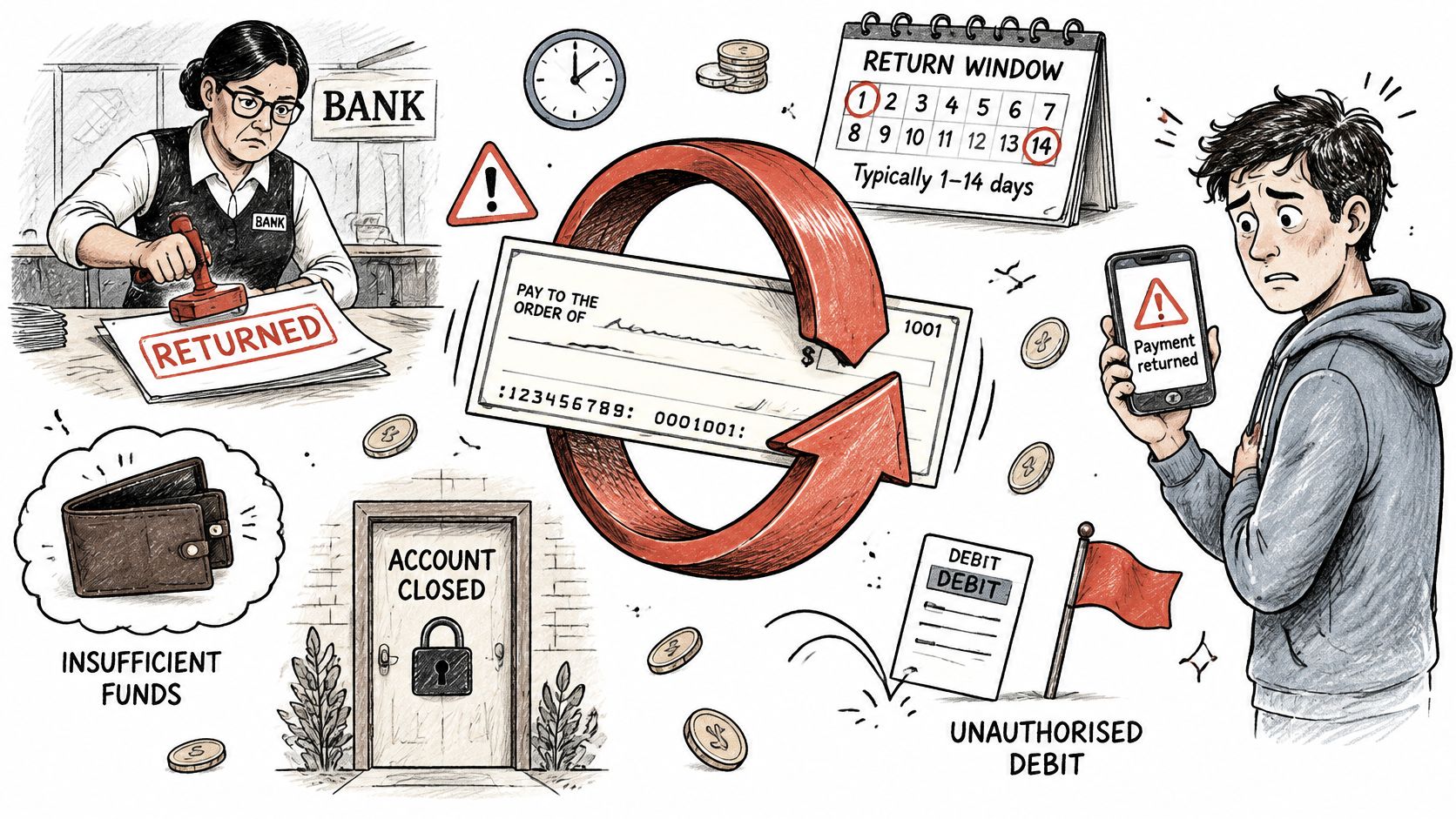
ACH returns, error reversals, and unauthorized-payment disputes aren't interchangeable. The applicable process depends on whether the entry is a credit or debit, the account involved, and the reason for the problem.
A closed account can cause an entry to fail, while insufficient funds can affect an ACH debit collection. Don't assume the ability to request a return gives you an unrestricted right to cancel a payment.
A Fedwire payment is final at its applicable acceptance point; treat ACH-funded balances as provisional until the relevant confirmation and return-risk requirements are satisfied.
For goods, services, or onward payouts you can't recover, don't rely on a pending ACH balance. Use your bank-confirmed status and an approved release policy rather than a screenshot or an internal available-balance label.
Build controls before you need a recall
An invoice email can be genuine while its replacement bank instructions are fraudulent. Call the beneficiary using a number already on file, and separate the employee changing vendor details from the employee approving payment.
Bookkeeping and Accounting of Florida Inc.’s guidance on preventing fake vendor payment fraud is useful for designing that separation in a small finance team. If a suspicious payment has already been released, contact your bank immediately and request recovery assistance; don't assume a recall will succeed.
For wallet-based workflows, retain a more detailed status record:
- Instruction accepted: Record the customer's request and authorization.
- Rail confirmation: Capture the bank or funding-system status.
- Internal ledger credit: Identify when the service credited its own balance.
- Final beneficiary payout: Record when the recipient received the money.
These records distinguish an internal balance update from completed delivery. They also give operations staff a specific stage to investigate instead of telling the customer only that the transfer is processing.
Africhange offers cross-border transfers with an upfront exchange-rate and recipient-amount preview, no hidden fees, and a wallet you can fund ahead of sending. Visit Africhange to check your transfer details and compare the recipient amount before choosing how to fund your next payment.