
What Is ACH Transfer? Timing, Fees and Security Explained

An ACH transfer is an electronic payment that moves money between bank accounts in the United States in batches, usually settling within one to two banking days. ACH stands for Automated Clearing House, the U.S. network that sorts and settles those payments.
If the money left your account this morning, why isn't it already in the recipient's account? That question exposes the gap in how many people think about ACH. Your banking app can accept an instruction instantly, but ACH still follows processing windows, bank cutoffs and banking days. When a payment also crosses borders, ACH may handle only the U.S. funding step, while currency conversion and payout happen afterward on separate rails.
Table of Contents
- What an ACH Transfer Is in Plain Terms
- How an ACH Transfer Travels Between Banks
- Credits, Debits and Everyday ACH Uses
- How Long ACH Takes and What It Costs
- How ACH Stays Secure and What to Do If Something Goes Wrong
- ACH Compared With Wire, Debit Card and Crypto
- Confirm Your Funding Route Before You Send With Africhange
What an ACH Transfer Is in Plain Terms
If you're asking what is ACH transfer in practice, it's an electronic credit or debit between U.S. bank accounts that's processed in batches rather than instantly. The Automated Clearing House network collects payment instructions, sorts them by receiving bank and settles them on a schedule.
Think of a wire as a taxi that picks up one passenger and drives directly to the destination. ACH is more like a scheduled bus. It collects many passengers, groups them by destination and delivers them at set processing times, which keeps the service widely available and generally inexpensive.
The Two Directions Money Can Move
- ACH credit: A payer pushes money into an account, as an employer does with a paycheck or direct deposit.
- ACH debit: A company pulls money from an account after the account holder authorizes it, as a utility provider does with a monthly bill.
Say you approve a bank transfer on Friday night to fund another payment. The app may show your instruction right away, yet ACH processing follows the next banking day rather than the app's clock. That distinction matters most when you need money for a due date, a supplier invoice or support for family abroad.
An international app being open at midnight doesn't move the U.S. bank cutoff. The payment still waits for the ACH timetable.
So carry one idea forward. ACH is a domestic U.S. bank rail, and an international transfer may use it for only the first funding step before conversion and payout begin.
How an ACH Transfer Travels Between Banks
One paycheck, bill or supplier payment travels through several hands before it becomes spendable money. The Federal Reserve guide to FedACH services describes an ACH transfer as a batch-processed electronic credit or debit rather than a real-time message, with each bank settling through its Federal Reserve settlement account.
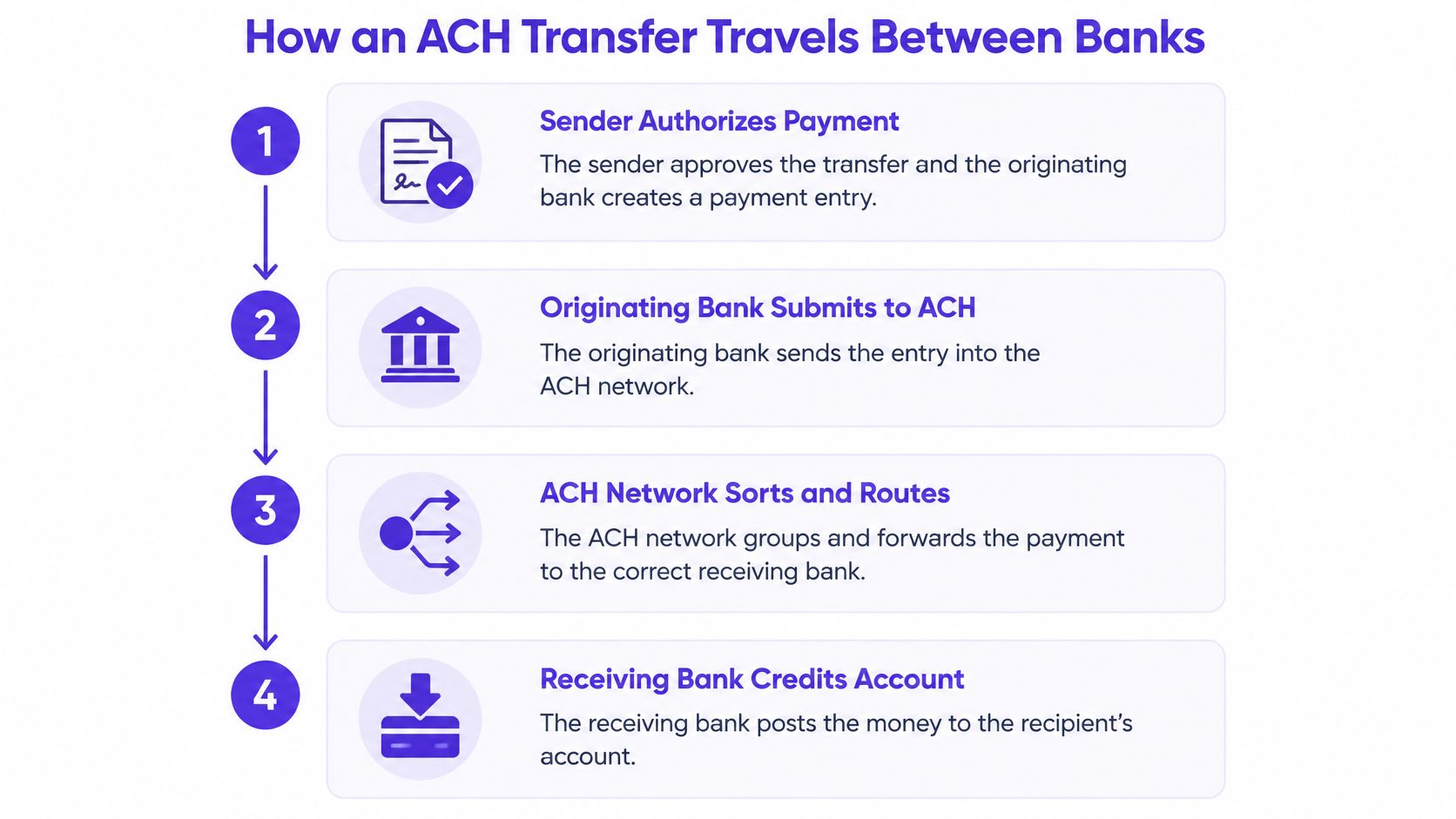
The Five Stages of One Payment
- The sender authorizes the payment. You approve the amount and destination, or you've already authorized a company to collect it. Your bank, called the originating depository financial institution, turns that approval into a payment entry.
- The originating bank submits the entry. It groups your entry with others and sends the batch to an ACH operator. Your payment isn't travelling alone at the moment you tap confirm.
- The operator edits, sorts and routes entries. It checks the file, separates payments by receiving bank and forwards each entry to the right institution. This sorting step is what makes very large volumes manageable.
- The banks settle with each other. The operator debits and credits the participating banks' Federal Reserve settlement accounts. That's the bank-to-bank settlement behind the transfer you see in your app.
- The receiving bank posts the funds. Only then does the money appear in the recipient's account. Posting can fall on a later banking day than the day your own bank accepted the instruction.
Why Store and Forward Changes Timing
ACH uses a store-and-forward design. Entries wait for the next processing window instead of moving one by one in real time. Cutoff times, weekends, federal holidays, return processing and effective-date rules, which set the intended settlement date, can all shift when funds become available.
That's why a sending bank can show a payment as accepted while the receiving bank hasn't posted anything yet. Nothing is necessarily wrong. The instruction is in the batch, moving through sorting and settlement.
Practical rule: Treat "sent" as the start of processing, not proof that the recipient can spend the money.
This design supports high-volume, low-cost funding because banks share scheduled processing instead of handling every payment as a one-off urgent transfer. It also means you shouldn't assume ACH is instant, even when your app gives you instant confirmation.
Credits, Debits and Everyday ACH Uses
The scale is hard to grasp until you see the yearly totals. According to Nacha's ACH Network volume and value statistics, the network processed 35.2 billion payments worth $93 trillion in 2025, an average of nearly 141 million payments per day, with volume up 4.9% and value up 7.9% from 2024.
Credits made up 15.6 billion payments worth $61.3 trillion, while debits made up 19.6 billion payments worth $31.7 trillion. The difference is who starts the movement. A credit is pushed by the payer. A debit is pulled by a company the account holder has authorized to collect.
Where You Already Meet ACH
- Payroll direct deposit: Your employer starts an ACH credit and pushes wages into your account.
- Government benefits: An agency starts a credit and deposits the benefit payment.
- Supplier and contractor payments: A business starts a credit to pay an invoice from its bank account.
- Person-to-person transfers: The sender starts a credit from a linked bank account.
- Recurring household bills: The utility or insurer starts an ACH debit after you authorize collection.
- Loan, rent and gym autopay: The lender, landlord or gym starts a debit on the agreed schedule.
- Account top-ups for financial apps: You authorize the app or its bank partner to pull funds by debit, or you push funds by credit from your bank.
Some apps also market products alongside bank funding, such as an instant cash advance, but that's separate from ACH itself. ACH is the bank rail moving the money, whatever app feature sits on top of it.
Same Day ACH is the faster variant inside the same network, commonly used when a business needs quicker settlement for payroll corrections or supplier payments. If you're paying someone on a predictable schedule, ACH usually fits well. If you're reacting to an urgent need today, timing matters more than saving a small fee.
How Long ACH Takes and What It Costs
An ACH payment can be initiated in seconds, but that does not mean the recipient can use the funds right away. The cutoff time, business-day calendar and any later payout steps all affect delivery. The table gives typical timing and fees; your bank's fee schedule and cutoff determine what applies to your payment.
| Transfer type | Typical timing | Typical bank fee | Key limit or note |
|---|---|---|---|
| Standard ACH credit | 1 to 2 banking days | Often free for personal account-to-account transfers | Settlement can post earlier than the outer window |
| Standard ACH debit | 1 to 2 banking days | Often free for consumers. Businesses usually pay a low per-entry origination fee | Generally cannot be scheduled more than one banking day ahead |
| Same Day ACH | Same business day if eligible | Bank schedule sets the fee, often near the standard ACH charge | Per-payment limit is set by Nacha. Cutoffs apply |
| Submitted on a weekend or holiday | Next banking day or later | Same as the underlying type | Business-day calendar controls the start date |
| International ACH | Not eligible for Same Day ACH | Sending bank sets the origination fee | A foreign payout needs a separate payment rail |
What the Banking Calendar Does to Your Date
Nacha's guide to the basics of ACH says the network operates for approximately 23¼ hours each business day, settles four times daily, and processes roughly 80% of ACH payments within one banking day or less. Standard entries may settle the same business day, the next banking day or two banking days later. Debits generally cannot be scheduled more than one banking day into the future.
Suppose you submit a payment on Monday before your bank's cutoff. It enters Monday's processing and may settle Tuesday. The recipient can generally plan for Tuesday or Wednesday, rather than the moment you press send.
Submit the same payment on Friday evening after the cutoff, and the result changes. Saturday and Sunday are not banking days, so processing effectively starts Monday and settlement may arrive Tuesday. The payment was initiated Friday, but the recipient may wait four calendar days for the funds.
Starting a payment and making funds available are different events. Your confirmation marks the first one, not necessarily the second.
Fees and the Steps Beyond the Network
Personal account-to-account ACH transfers are often free. Businesses usually pay their bank a low per-entry fee to create and submit payment files. Check the fee schedule for your account before sending a large or recurring payment.
ACH settlement is one stage, not the whole journey, when funds are going abroad. Bank acceptance, fraud and sanctions screening, reconciliation, currency conversion and the destination payout can add time. A transfer through an international payment platform may therefore take longer than the ACH portion alone.
To estimate delivery, start with your bank's cutoff and allow one banking day for standard ACH, then account for any separate payout steps if the money is leaving the United States. If the start date falls on a weekend or federal holiday, begin counting from the next banking day.
How ACH Stays Secure and What to Do If Something Goes Wrong
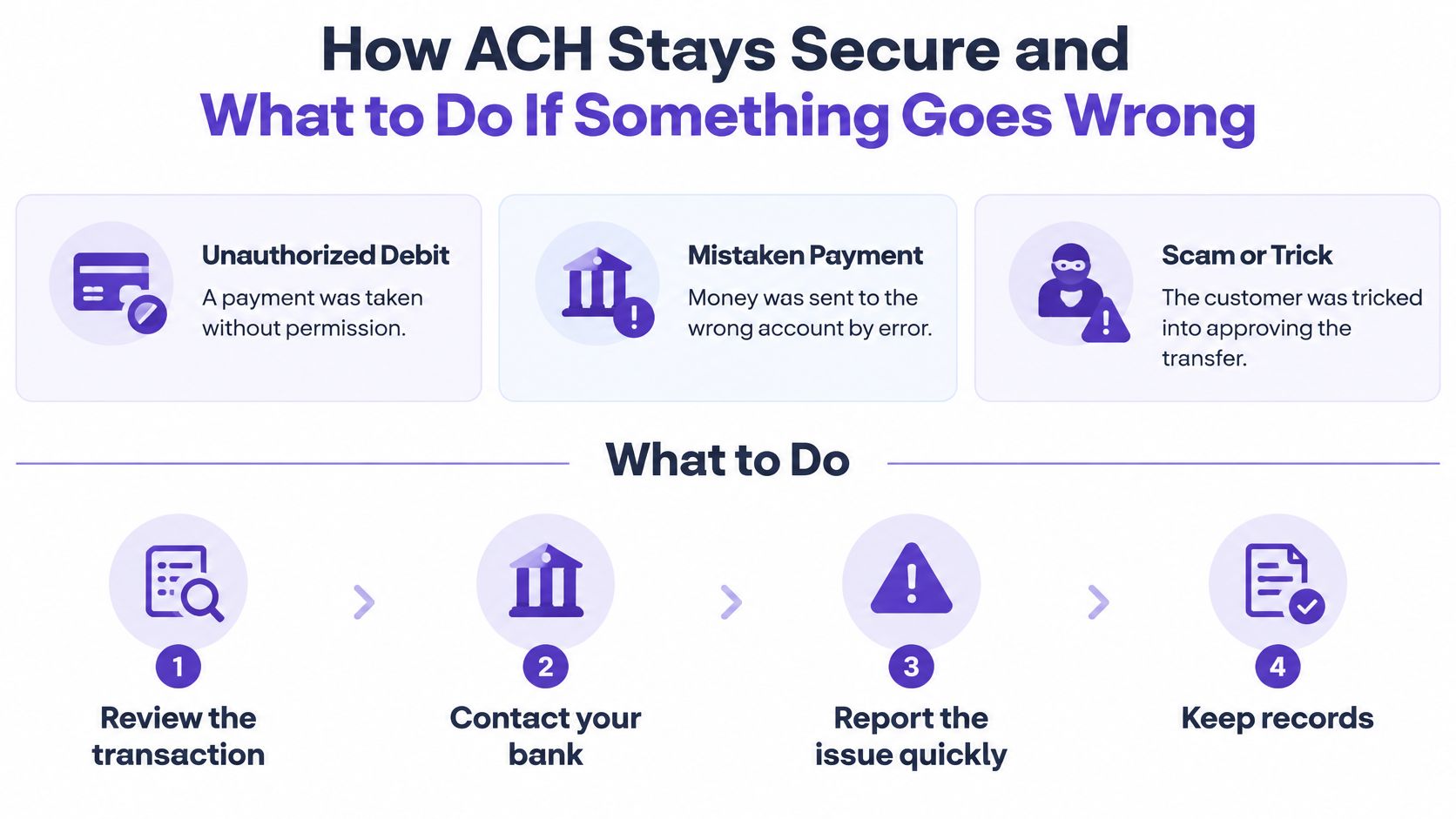
Three problems sound similar but lead to very different outcomes. Separating them is the first step when a payment looks wrong.
- Unauthorized debit: Money was taken without your permission by someone who had no actual authority.
- Mistaken payment: You or your business sent money to a legitimate but wrong account, or used the wrong amount.
- Scam approval: Someone manipulated you into approving the transfer yourself, often by impersonating a supplier, bank or relative.
The Consumer Financial Protection Bureau's electronic fund transfer FAQs explain that under Regulation E, reporting quickly after loss or theft can limit consumer liability to as much as $50, while failing to report an unauthorized transfer appearing on a statement within 60 days can expose the consumer to additional losses.
Those protections don't mean your bank can reverse every mistaken payment or every transfer you approved after being deceived. Once funds reach a valid account and settlement has occurred, recovery may require the receiving bank and account holder to cooperate. Speed still helps, so act the moment you spot the problem.
Your Prevention and Response Checklist
- Verify routing and account numbers. Check them against a statement, voided check or portal you already trust, not a forwarded message.
- Confirm the recipient independently. Call a phone number you already have before sending to new or changed details.
- Don't act on email-only payment changes. A supplier asking you to switch bank details by email needs a voice confirmation first.
- Review recurring authorizations. Cancel ACH debits you no longer recognize or need, and keep a list of active ones.
- Check statements at least weekly. The same habit helps you spot problems early and dispute a repeated card charge on other payment methods too.
- Contact your bank immediately. Ask what can still be stopped, returned or investigated, and keep records of every call.
Our guide to keeping online transactions secure covers the wider habits behind these checks. Remember the boundary though. Regulation E covers the U.S. funding leg, while reversal and complaints for a foreign payout follow the destination, payout method and settlement status.
ACH Compared With Wire, Debit Card and Crypto
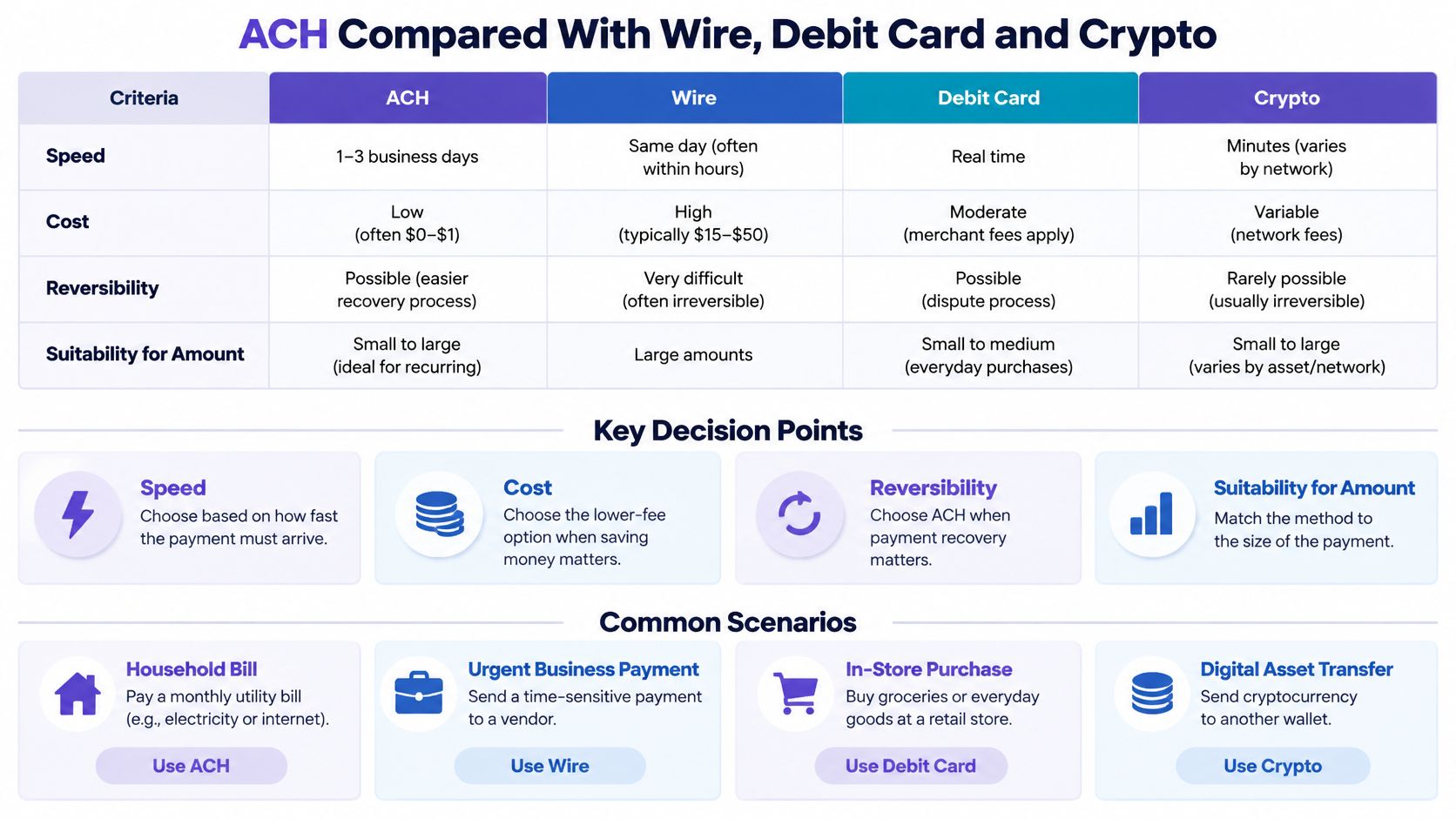
No rail wins on every criterion. Use the table to narrow your choice, then test it against the amount and deadline in front of you.
| Rail | Typical speed | Typical cost | Reversibility | Best for |
|---|---|---|---|---|
| ACH | 1 to 2 banking days. Same day if eligible | Often free to low | Limited. Unauthorized debits covered by Regulation E | Recurring bills, payroll and predictable payments |
| Wire | Often same day | Flat bank fee set by the sending bank, higher than ACH | Very difficult to recall once sent | Urgent, large, time-sensitive sums |
| Debit card | Authorization is immediate. Settlement takes 1 to 3 days | Card or foreign exchange markup may apply | Chargeback possible for qualifying disputes | Small, immediate purchases |
| Crypto (USDT or BTC) | Minutes to hours, set by the network | Network fees plus exchange spread | Generally irreversible | Users comfortable with wallets and price volatility |
Four Tests Before You Choose
Speed decides first when there's a hard deadline. A $10,000 urgent supplier payment due today points to a wire, even though the fee is higher and recall is very difficult. Our explainer on how SWIFT transfers work shows how international wires move between banks.
Cost matters most when payments repeat. A $1,500 monthly rent payment set up as recurring ACH from a checking account avoids paying wire-level fees twelve times a year.
Reversibility protects you when details are new. ACH gives defined routes for unauthorized debits, cards allow chargebacks for qualifying disputes, and wires and crypto give you very little room after sending.
Suitability for the amount keeps small payments simple. A $300 freelance invoice paid by debit card gives immediate authorization without collecting bank details, though settlement behind the scenes still takes days.
Crypto transfers can settle in minutes to hours, but network fees and exchange spreads shift, the price can move before conversion, and most transfers cannot be reversed. Also keep the boundary clear. Funding an international payment by U.S. ACH doesn't make the whole payment an ACH payment, because conversion and destination payout run separately.
Choose ACH for recurring, predictable and non-urgent payments. Choose a wire for urgent large sums, a debit card for small immediate purchases, and crypto only if you're comfortable managing wallets and volatility.
Confirm Your Funding Route Before You Send With Africhange
A U.S. ACH transfer is the funding step, not the entire cross-border payment. After funds are collected, currency conversion and payout to the recipient happen separately. Africhange also offers bank transfers, debit cards, Interac e-Transfer in Canada and stablecoin funding, depending on the country and route.
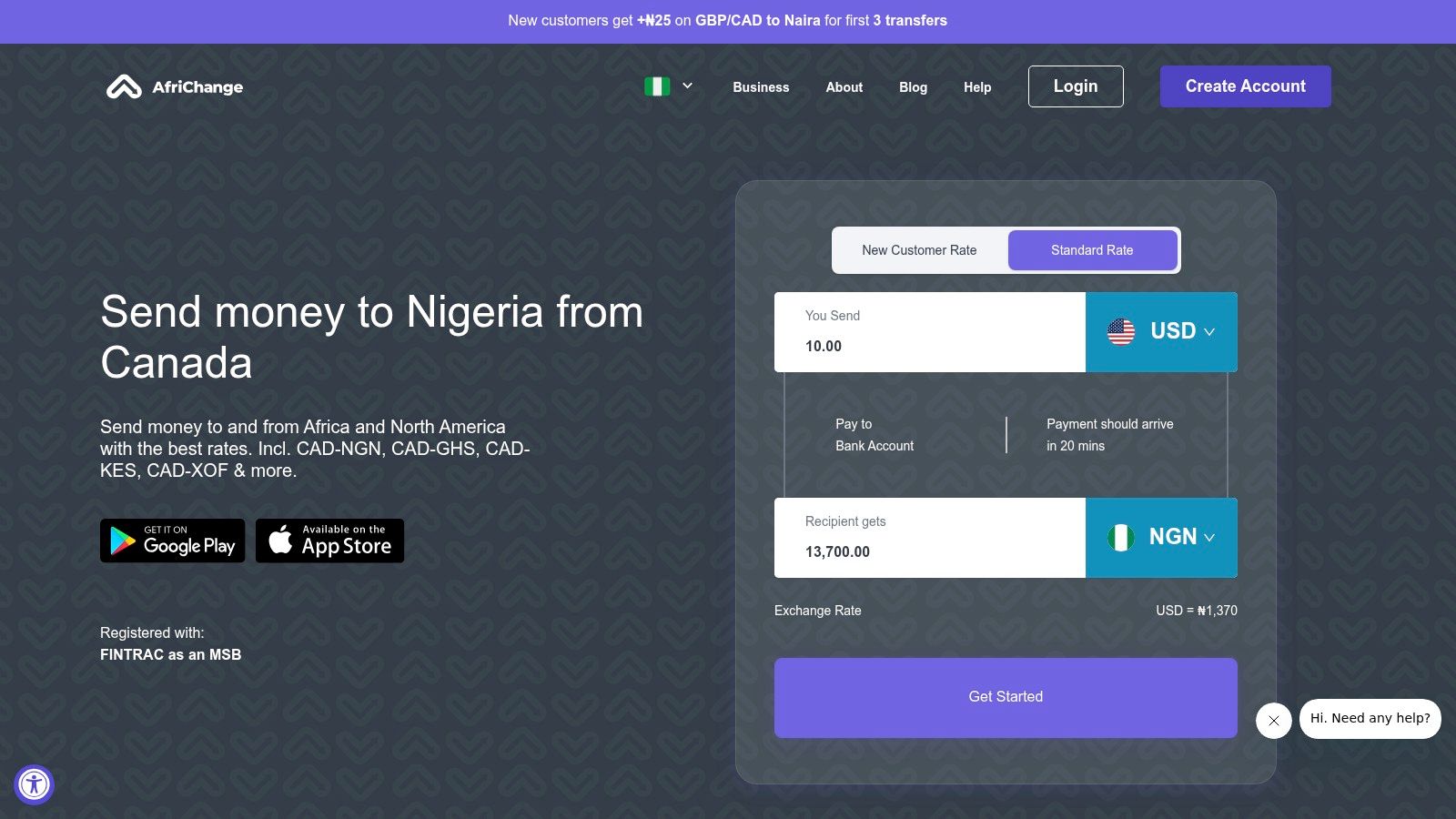
Before you confirm, check the exchange rate and the amount the recipient will receive in the transfer preview. Africhange has no hidden fees. The preview helps you see the exchange rate and recipient amount before sending, while your bank's ACH timing depends on banking days and cutoffs. Where available, a wallet lets you store funds and fund it for faster sending. Schedule Transfer lets you send later or regularly at a particular time.
Check These Five Things in Order
- Confirm your country's funding methods in the app or on the website before starting.
- Review the transfer preview, including the exchange rate, recipient amount and fees.
- Choose bank transfer and complete the bank authorization for the ACH funding step.
- Compare the exchange rate and recipient amount in the preview with standard ACH timing, banking days and cutoffs.
- Set a schedule for recurring payments so they do not rely on memory.
An app's availability does not change ACH processing windows. Check the funding route and allow for banking days and cutoffs before sending.
Fund a transfer from a U.S. bank account by ACH, then review the live exchange rate and recipient amount before confirming. Visit Africhange to check the funding methods available for your country and set up a one-off or recurring transfer.