
AfriChange Has Consistently Offered Better Rates Than LemFi
Our analysis of 49,000+ matched rate observations shows how Africhange compared with LemFi across UK–Nigeria transfers, including rate frequency, difference and consistency.


Here’s why Africhange should be your first choice for UK–Nigeria transfers.
Exchange-rate differences that look small at £1 can become meaningful at £500, £1,000 or £5,000. We analysed historical quoted-rate records for Africhange and LemFi from BestRates, matching tens of thousands of observations across both directions to see which platform quoted the better rate more often — and by how much.
Analysis conducted by Africhange using historical quoted-rate records for Africhange and LemFi sourced from BestRates.
The result, in three parts:
- Frequency — how often did Africhange quote the better rate?
- Magnitude — by how much, typically, across all matched observations?
- Persistence — did the advantage hold up over time, or was it a blip?
Method and scope
- UK → Nigeria (GBP → NGN): 37,521 matched rate observations, January 2025–August 2026
- Nigeria → UK (NGN → GBP): 11,552 matched rate observations, March–August 2026, the period for which matched Africhange data was available in this dataset
- Data source. The historical rate records used in this analysis were sourced from BestRates, which tracks quoted exchange rates across remittance providers. The dataset contains timestamped rate records for both Africhange and LemFi over the periods analysed.
- Rates were sampled periodically — roughly every 20 minutes for Africhange and every 15 minutes for LemFi — so observations represent repeated snapshots of quoted rates rather than independent customer transactions.
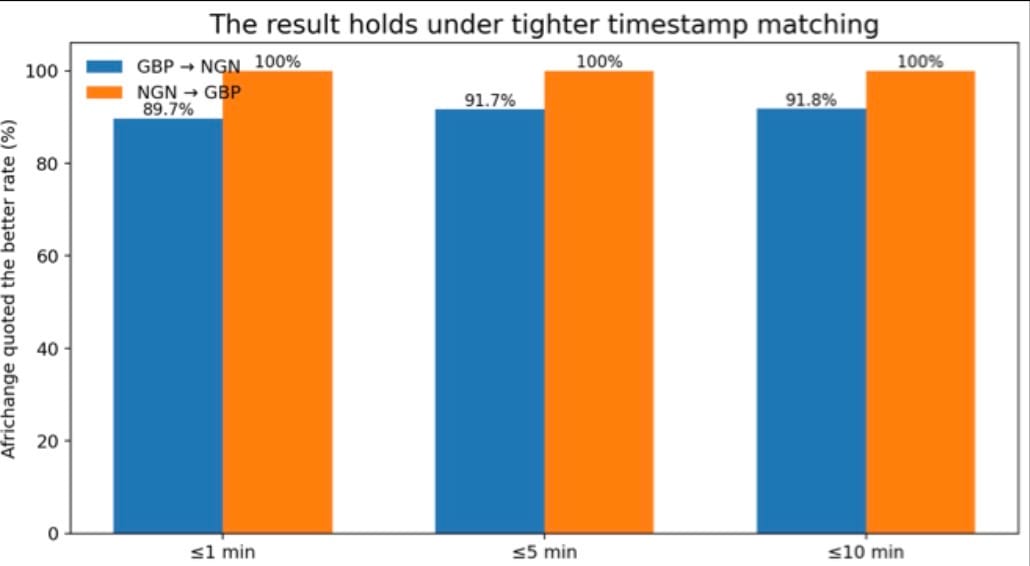
- Rates were matched by nearest timestamp within a 10-minute window. The median gap between matched quotes was 2.2 minutes for GBP→NGN and 4.5 minutes for NGN→GBP. Because quotes weren't always captured at exactly the same second, we also re-ran the analysis using progressively tighter 5-minute and 1-minute matching windows. As shown below, the overall result remained similar even at the strictest threshold.
- What we're comparing: this analysis isolates the exchange rate quoted by each platform at a given point in time. It doesn't attempt to model the full economics of a completed transfer, where applicable fees and other transaction-specific factors can affect the final amount received.
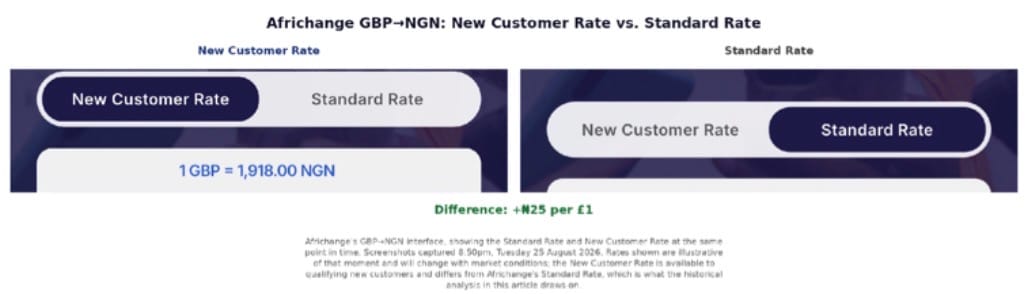
- Customer-specific rates. The rate available on a remittance platform can depend on customer eligibility. For GBP→NGN, Africhange currently displays both a Standard Rate and a New Customer Rate in its app, with the latter available to qualifying new customers; at the time captured, the New Customer Rate was ₦25/£ above the Standard Rate.5 The historical analysis compares the rates captured in the underlying dataset rather than attempting to reconstruct every customer-specific rate or promotional benefit for which an individual user might have qualified.
Sending money to Nigeria (GBP → NGN)
Frequency
|
Matching tolerance |
Observations |
Africhange quoted the better rate |
|
1 minute |
5,795 |
89.7% |
|
5 minutes |
28,632 |
91.7% |
|
10 minutes |
37,521 |
91.8% |
At the 10-minute tolerance, rates were equal in 3.8% of observations and LemFi quoted the better rate in 4.4%.
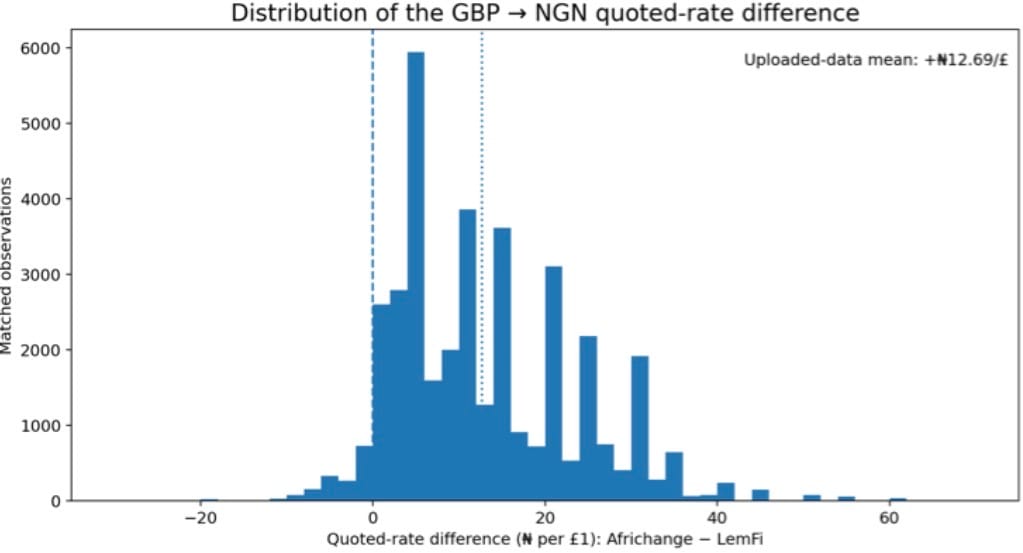
Magnitude — the rate difference (Africhange minus LemFi) across all 37,521 matched observations, including the ones where LemFi was better or the rates tied:
|
Percentile |
₦ difference per £1 (Africhange − LemFi) |
|
25th |
+₦5.00 |
|
50th (median) |
+₦10.00 |
|
75th |
+₦20.00 |
|
95th |
+₦30.00 |
|
Average (all observations) |
+₦12.69 |
Including the 4.4% of observations where LemFi quoted the better rate, the average difference across the full dataset still favored Africhange by ₦12.69 per £1.
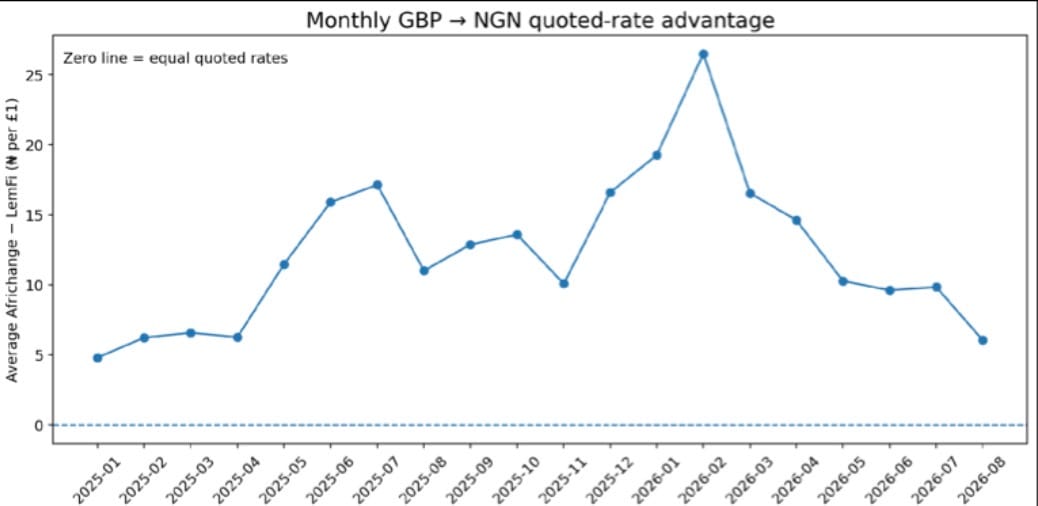
Persistence — Africhange's average monthly difference was positive in every one of the 20 months tracked, ranging from roughly ₦5 to ₦26 in Africhange's favour per £1 depending on the month.
For illustration, applying the historical average difference of ₦12.69/£ to different transfer amounts, before any fees:
|
Amount sent |
≈ Quoted-rate difference in ₦ |
|
£500 |
₦6,345 |
|
£1,000 |
₦12,690 |
|
£2,000 |
₦25,380 |
|
£5,000 |
₦63,450 |
Sending money to the UK (NGN → GBP)
Frequency
|
Matching tolerance |
Observations |
Africhange quoted the better rate |
|
1 minute |
3,142 |
100% |
|
5 minutes |
7,712 |
100% |
|
10 minutes |
11,552 |
100% |
Across every matched observation in this dataset, at every tolerance tested — including the 3,142 quotes captured within a minute of each other — Africhange's quoted rate was the better one.
Magnitude — average quoted GBP equivalent per ₦1,000,000:
|
Platform |
Avg. quoted GBP equivalent per ₦1,000,000 |
|
Africhange |
£522.72 |
|
LemFi |
£499.16 |
And the distribution of the difference itself, across all 11,552 matched observations:
|
Percentile |
£ difference per ₦1,000,000 (Africhange − LemFi) |
|
25th |
+£20.61 |
|
50th (median) |
+£23.20 |
|
75th |
+£26.18 |
|
95th |
+£30.14 |
|
Average (all observations) |
+£23.56 |
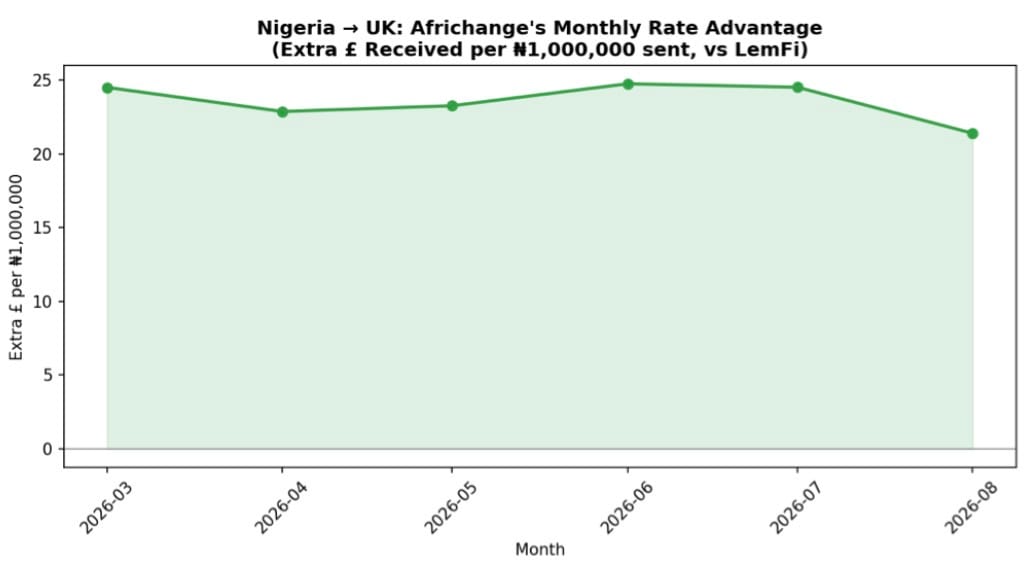
Persistence — the average monthly difference was positive in each of the 6 months tracked (March–August 2026), ranging from roughly £21 to £25 in Africhange's favour per ₦1,000,000.
For illustration, applying the historical average difference to different transfer amounts, before any fees:
|
Amount sent |
≈ Quoted-rate difference in £ |
|
₦500,000 |
£11.78 |
|
₦1,000,000 |
£23.56 |
|
₦2,000,000 |
£47.12 |
|
₦5,000,000 |
£117.81 |
What this means for users
The practical takeaway isn't that Africhange will have the better rate every time you open the app. Exchange rates move, and what you actually receive can also depend on fees, eligibility and the specific offer available to you at the time.
What the historical data does suggest is that Africhange is worth including when you compare rates. For GBP→NGN, Africhange quoted the better rate in 91.8% of matched observations, with an average difference of ₦12.69 per £1 across the full dataset. At that historical average, a £500 transfer corresponds to roughly ₦6,345 in additional quoted Naira value; at £1,000, roughly ₦12,690.
For NGN→GBP, the pattern was even more consistent over the six months measured: Africhange quoted the better rate in every matched observation, with an average difference equivalent to £23.56 per ₦1,000,000.
The rate available to an individual customer can also depend on eligibility. Africhange currently offers qualifying new UK customers a New Customer Rate for GBP→NGN; at the time captured, it was ₦25 per £1 above the Standard Rate.5 That's separate from the ₦12.69/£ historical difference above: the former compares two Africhange rates at a single point in time, while the latter is the average Africhange–LemFi difference across the historical dataset. At the ₦25/£ difference shown, the New Customer Rate corresponds to ₦12,500 more on £500 or ₦25,000 more on £1,000 than Africhange's Standard Rate at that moment.
For users, the simplest approach remains to compare what you'll actually receive before confirming a transfer. The historical evidence here doesn't replace that comparison — it's a reason to include Africhange in it. And the bigger the transfer, or the more often you send, the more a seemingly small rate difference can add up.
For illustration, applying the historical average of ₦12.69/£ to twelve £500 transfers produces a cumulative quoted-rate difference of around ₦76,140. That isn't a forecast; it's simply what the historical average would imply at that pace.
Beyond the rate
The UK→Nigeria corridor is a significant and highly contested remittance market. Estimates of its size vary because bilateral remittance flows are difficult to measure: the UK government has cited roughly $2 billion a year flowing from the UK to Nigeria, while other industry estimates have placed the corridor above £3 billion annually. The corridor serves a large Nigerian diaspora and attracts both specialist remittance companies and some of Nigeria’s biggest fintechs. Competition isn’t limited to the exchange rate either: providers compete on new-customer offers, referral incentives, transfer fees, funding options and the broader financial products they can offer diaspora customers.
For Nigerian customers in the UK, the competition has increasingly moved beyond simply being able to send money home. Providers are competing on the rate, the cost of sending, new-customer incentives and, increasingly, what else the product can do for customers living between two financial systems.
That competitive landscape changed considerably during the 20-month period covered by this analysis.
In April 2025, Moniepoint — one of Nigeria's largest fintechs — launched MonieWorld, a remittance product built specifically for the UK's African diaspora through its UK subsidiary. Moniepoint later said MonieWorld had recorded a 70% increase in monthly transaction volume among diaspora users during its run. In August 2026, the company announced that MonieWorld was undergoing a strategic transition and that its UK remittance operation would be wound down as resources were redirected toward its core African markets.
The GBP→NGN dataset begins in January 2025. That means the 20-month window predates MonieWorld's April 2025 launch, spans its time in the UK remittance market, and reaches its announced wind-down in August 2026. We're not drawing a conclusion about Moniepoint's business from that decision; the significance here is simply that the competitive environment changed during the period covered by the data.
Africhange’s own trajectory provides another piece of context. Currenzo Nigeria Limited, Africhange’s Nigeria Subsidiary, ranked 11th in the Financial Times and Statista’s 2026 list of Africa’s Fastest-Growing Companies, based on revenue growth between 2021 and 2024. That growth is particularly notable given that Africhange has been built as a bootstrapped business, rather than through the large institutional funding rounds common across African fintech.
The ranking measures the African business rather than Africhange’s UK operation specifically, so it isn’t evidence of UK market share. But it matters to the UK story in a different way: the UK product isn’t being built in isolation. It sits within a growing cross-border payments business that has continued expanding its product and geographic footprint.
That now includes bidirectional GBP⇄NGN money movement. It also introduced UK bank accounts powered by Griffin, with dedicated sort codes and account numbers. Eligible deposits are protected by the FSCS up to £120,000 per depositor, with the limit applying across eligible deposits held with Griffin. Africhange has also introduced volume-based rate improvements for qualifying transfers.
Taken together, the picture is broader than rates alone. During a period in which the UK–Nigeria remittance market saw new entrants and exits, Africhange’s underlying business ranked among Africa’s fastest-growing companies, its UK proposition expanded, and its average quoted-rate difference against LemFi remained positive in every month measured.
Product information reflects publicly available terms as of August 2026.
The bottom line
Across 37,521 matched GBP→NGN observations, Africhange quoted the better rate 91.8% of the time. Restricting the comparison to quotes captured within one minute of each other reduces the dataset to 5,795 observations, but Africhange still leads in 89.7% of them. Its average monthly difference was positive in every one of the 20 months tracked.
For NGN→GBP, Africhange quoted the better rate in all 11,552 matched observations between March and August 2026 — including all 3,142 observations matched within one minute.
But the case for Africhange over this period isn’t only about the rate. The 20-month window spans a changing UK–Nigeria remittance market, including MonieWorld’s entry and announced exit. Over that period, Africhange expanded its UK proposition beyond the basic remittance transaction, while the Nigeria subsidiary was ranked 11th in the Financial Times and Statista’s 2026 list of Africa’s Fastest-Growing Companies.
None of those things, individually, tells you which provider will give you the best deal on your next transfer. But taken together, they tell a broader story: Africhange has combined a persistent historical rate advantage against LemFi with a growing product offering and a wider business that has demonstrated significant growth.
Twenty months of data can tell us something a single rate check cannot: whether an advantage was an isolated moment or whether it persisted as the market around it changed.
In this dataset, it persisted. The data has had its say. Next time you’re sending money between the UK and Nigeria, try Africhange.